




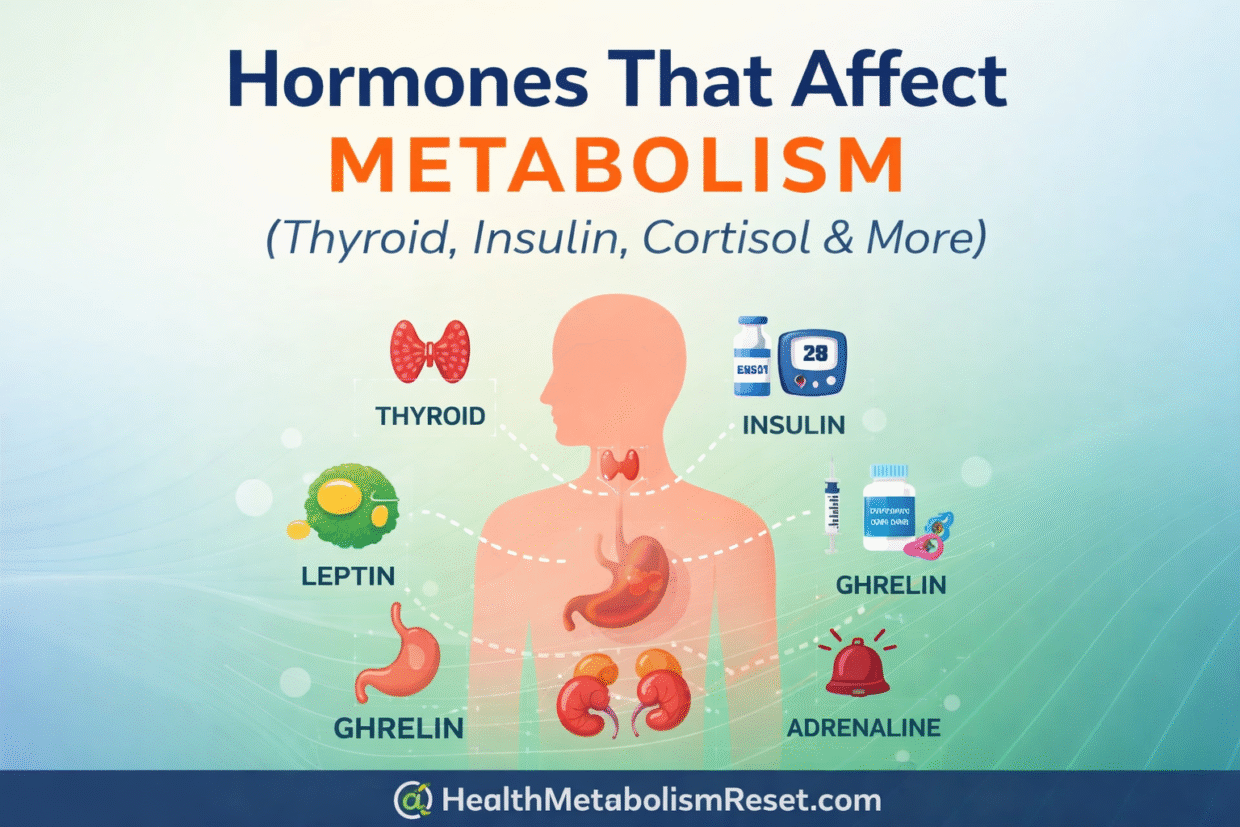
Your metabolism is the process your body uses to convert food into energy. While lifestyle and genetics play a big role, hormones are some of the most powerful regulators of metabolic activity. These chemical messengers help control how fast or slow your body burns calories, how your cells use fuel, and how your appetite and energy levels are balanced. In simple terms, understanding hormones that affect metabolism helps explain why some people naturally have a fast metabolism, while others do not (Cleveland Clinic).
Hormones act like signals throughout the body. When they are balanced, metabolic processes tend to run smoothly. But when hormone levels change — either naturally or due to medical or lifestyle factors — metabolism may speed up, slow down, or become less efficient (NIH). Below is a closer look at how hormones control metabolism and how the thyroid, insulin, cortisol, leptin, ghrelin and other hormones play a role.
To better understand how the body converts food into energy, you can read our complete guide on what metabolism really means and how it works here: Metabolism Guide
Thyroid Hormones — The Body’s Metabolism Regulator
The thyroid and metabolism are closely connected. The thyroid gland produces hormones called T3 (triiodothyronine) and T4 (thyroxine), which directly influence how quickly your body converts nutrients into energy (NIH). Higher thyroid hormone levels generally increase metabolic activity, while lower levels decrease it (Journal of Clinical Endocrinology & Metabolism).
- Thyroxine (T4) and Triiodothyronine (T3): These increase the number of calories your body uses at rest and during activity. Higher levels are associated with increased energy use, while lower levels are linked to slower metabolism. PMC
- Thyroid-stimulating hormone (TSH): Regulates the release of T3 and T4 via feedback from the hypothalamus and pituitary glands.
People with elevated thyroid hormone levels may experience a faster metabolism, increased heat sensitivity, appetite changes and sometimes weight loss. Meanwhile, low thyroid hormone levels may slow metabolism and contribute to fatigue or weight gain (Cleveland Clinic).
So, when people talk about hormone imbalance and metabolism, the thyroid is one of the first places doctors look — because even small hormonal changes can significantly affect energy use.
If you want a broader explanation of what a fast metabolism is and how it affects the body, explore our detailed guide here: Fast Metabolism
Insulin — Energy Storage, Fuel Use and Metabolic Balance
Insulin and metabolism also work hand-in-hand. Insulin is released by the pancreas to help move glucose from the bloodstream into cells so it can be used as fuel (Harvard Health). When the body responds normally to insulin, blood sugar is controlled efficiently.
However, when insulin sensitivity changes, the body may begin storing more glucose as fat rather than using it immediately for energy. This doesn’t necessarily create a fast metabolism — but it does change how the body handles, stores and uses energy, which is still a major part of metabolic health (CDC).
Cortisol — The Stress Hormone and Metabolic Response
When discussing cortisol and metabolism, it’s important to understand that cortisol is released during stress to help the body access stored energy (NIH). Short-term cortisol release can increase alertness and fuel availability.
However, long-term elevated cortisol may disrupt appetite, sleep and energy balance, and may even contribute to weight changes or fatigue over time (Journal of Endocrinology). So while cortisol can temporarily increase energy use, a constant stress response does not equal a healthy fast metabolism.
Leptin and Ghrelin — Appetite & Hunger Signals
Two appetite-related hormones — leptin and ghrelin hormones — indirectly affect metabolic health.
Leptin is released by fat cells and signals fullness to the brain. Higher leptin levels normally reduce hunger. Ghrelin has the opposite effect — it stimulates appetite when the stomach is empty (Mayo Clinic).
These hormones help regulate:
- hunger
- satiety
- calorie intake
- long-term weight balance
So while they don’t directly speed up metabolism like thyroid hormones, they strongly influence overall metabolic balance and energy regulation.
You can also review the early signs of a high metabolism in our separate article here: signs of a high metabolism
Adrenaline — Short-Term Metabolic Activation
Adrenaline is another hormone that influences energy use, especially during “fight or flight” responses (Cleveland Clinic). When adrenaline rises, the body increases heart rate and temporarily boosts energy availability. This effect is usually short-term and not a permanent metabolic state.
Hormone Balance Matters More Than Individual Hormones
It is important to remember that hormones do not work in isolation. The endocrine system creates a network that regulates metabolism together, including the thyroid, pancreas, adrenal glands and brain signaling pathways (NIH).
This explains why:
- Some people naturally burn energy faster
- Others store energy more efficiently
- And some experience changes when hormone levels shift
A hormone imbalance and metabolism change may require medical evaluation — especially if weight changes occur unexpectedly.
On the other hand, if your metabolism feels sluggish, we’ve also covered the common signs of a slow metabolism here: Slow Metabolism Explained
When To Speak With a Healthcare Professional
You should seek medical advice if you experience:
- unexpected weight loss or gain
- chronic fatigue or weakness
- rapid heart rate or tremors
- severe anxiety
- heat or cold intolerance
- persistent appetite change
These symptoms may — but do not always — relate to thyroid or other hormone changes (NHS).
Final Thoughts
Hormones like thyroid hormones, insulin, cortisol, leptin and ghrelin all play essential roles in how hormones control metabolism. Some may contribute to a fast metabolism, while others influence appetite, energy balance or how the body stores nutrients. Most of the time, metabolism varies naturally between individuals — and hormone balance is just one part of the picture.
Understanding hormones that affect metabolism helps provide clarity — but it’s always best to speak with a healthcare professional about medical concerns or possible hormone changes.
Continue Learning About Metabolism
• What Is Metabolism? — https://healthmetabolismreset.com/metabolism/
• Fast Metabolism Guide — https://healthmetabolismreset.com/fast-metabolism-symptoms-benefits/
• Fast Metabolism Symptoms — https://healthmetabolismreset.com/fast-metabolism-symptoms/
• Signs of High Metabolism — https://healthmetabolismreset.com/signs-high-metabolism/
• Slow Metabolism Guide — https://healthmetabolismreset.com/slow-metabolism/
FAQ,s
What are the main hormones that affect metabolism?
Several hormones help regulate how your body uses and stores energy. The most important hormones that affect metabolism include thyroid hormones (T3 and T4), insulin, cortisol, leptin, ghrelin and adrenaline. These hormones influence calorie use, appetite, fat storage, and energy balance throughout the body (Cleveland Clinic). When these hormones are balanced, metabolism tends to function normally. When levels shift significantly, metabolism may speed up, slow down, or become less efficient.
How does the thyroid affect metabolism?
The thyroid and metabolism are strongly connected. Thyroid hormones control how quickly cells convert nutrients into usable energy. Higher thyroid activity can increase metabolic rate, while low thyroid levels may slow it down (NIH). This is why thyroid disorders sometimes cause weight or energy-level changes. Only a healthcare provider can diagnose a thyroid condition through proper testing.
Does insulin play a role in metabolism?
Yes. Insulin and metabolism are closely linked. Insulin helps move glucose from the blood into your cells so it can be used for energy (Harvard Health). When the body becomes less sensitive to insulin, energy processing can change — often leading to more glucose being stored as fat. This doesn’t necessarily create a “fast” metabolism, but it does influence how your body manages fuel.
Do hormones control metabolism completely?
No — how hormones control metabolism is only one part of the picture. Genetics, body composition (muscle vs fat), age, sleep, stress levels, medical conditions, and nutrition also play major roles (CDC). This is why two people can eat and move the same way yet still have different metabolic speeds.
Medical Disclaimer
The information in this article is for general educational purposes only and is not a substitute for professional medical advice, diagnosis or treatment. Metabolism and hormone health can vary widely from person to person, and some symptoms described here may also be related to medical conditions that require clinical evaluation.
Always speak with a qualified healthcare professional if you have questions about your health, hormone balance, metabolism, medication, or if you experience unexpected changes such as unexplained weight loss or gain, rapid heartbeat, anxiety, fatigue, or appetite changes. Do not ignore or delay seeking medical advice because of something you have read on this website.
Sources
Here are the exact live URLs referenced in this article:
- Healthline – 9 Hormones That Affect Your Weight
https://www.healthline.com/nutrition/9-fixes-for-weight-hormones Healthline - PubMed – Thyroid Hormone Regulation of Metabolism
https://www.ncbi.nlm.nih.gov/pmc/articles/PMC4044302/ PMC - Better Health Victoria – Obesity and Hormones
https://www.betterhealth.vic.gov.au/health/healthyliving/obesity-and-hormones Better Health Channel - Houston Family Practice – Hormonal Imbalance & Weight Gain
https://www.houstonfamilypractice.com/blog/how-hormonal-imbalances-cause-weight-gain-ways-to-manage-it Houston Family Practice - PubMed – Adipose-derived Hormones
https://en.wikipedia.org/wiki/Adipose-derived_hormones Wikipedia - EPA – Overview of the Endocrine System
https://www.epa.gov/endocrine-disruption/overview-endocrine-system

Robert Harisson
ISSA Certified Personal Trainer | Nutrition Specialist (Cornell University)
Robert Harrison is an ISSA-certified personal trainer and a nutrition graduate from Cornell University. With over five years of fitness coaching and two years of health-blog writing, he specializes in metabolism, women’s health, weight management, and natural wellness. Robert creates simple, science-backed content that helps readers make safe and informed decisions. His work reflects strong E-E-A-T principles, combining real-world coaching experience with evidence-based nutrition knowledge.