




You did the hard part. You lost the weight. And now you are dealing with something nobody warned you about — loose skin that does not seem to be going anywhere.
If you are wondering how to tighten loose skin after weight loss, the honest answer is that some approaches work, some take time, and some are a complete waste of money. This guide covers all three — clearly and without sugarcoating anything.
We cover how to avoid loose skin after losing weight if you are still in the process, what to do if the loose skin is already there, which treatments are worth exploring, and when surgery becomes the only real answer.
If you want to understand why loose skin happens in the first place, read our detailed guide on Loose Skin After Weight Loss — Causes and Mistakes.
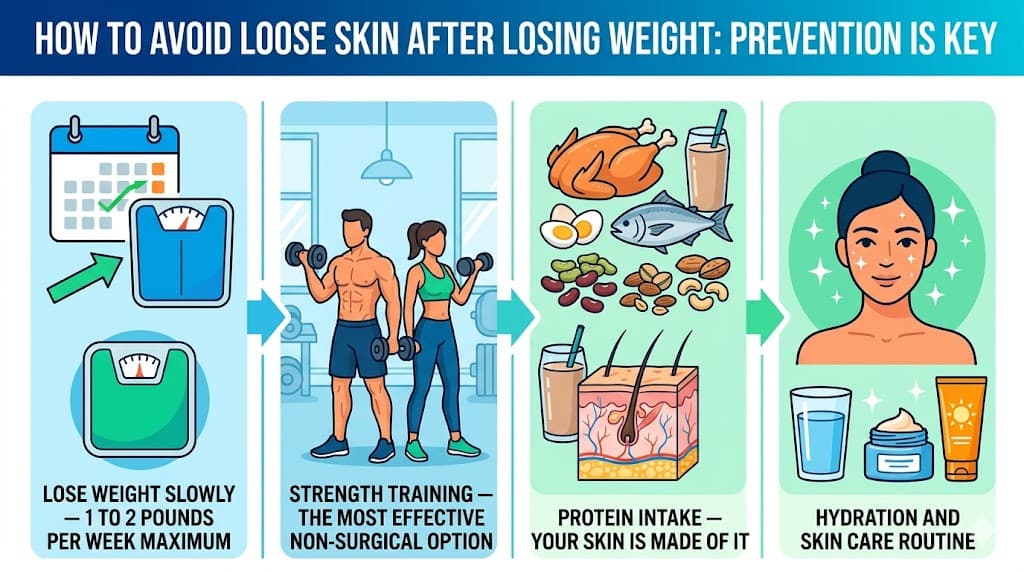
Part One — How To Avoid Loose Skin After Losing Weight
Prevention is always better than treatment. If you are still in the process of losing weight, these steps give your skin the best possible chance of keeping up with your body.
- Lose Weight Slowly — 1 to 2 Pounds Per Week Maximum
- Strength Training — The Most Effective Non-Surgical Option
- Protein Intake — Your Skin Is Made Of It
- Hydration and Skin Care Routine
Lose Weight Slowly — The Foundation of How To Prevent Loose Skin During Weight Loss
This is the single most important thing you can do.
When you lose weight slowly, your skin has time to adapt. Skin is elastic but that elasticity has limits. Push past those limits with extreme rapid weight loss and you end up with far more loose skin than necessary — regardless of everything else you do.
The target is 1 to 2 pounds per week. Not more. This pace is the most practical answer to how to prevent loose skin during weight loss because it gives your skin continuous time to shrink alongside your body rather than being left behind.
Anyone who lost large amounts of weight in weeks without loose skin either has exceptional genetics or used substances. That is not a realistic benchmark. Stop comparing yourself to those transformations.
Strength Training — The Most Effective Way To Tighten Loose Skin After Weight Loss
If there is one thing that consistently helps both prevent and improve loose skin after weight loss, it is strength training.
Here is why. When you lose fat, you remove the volume that was filling your skin from the inside. Strength training builds muscle — and muscle fills that space back up. Not with fat, but with lean mass that gives your skin something to sit against.
Compound exercises build the most overall muscle mass and are the most effective approach to tighten loose skin after weight loss naturally:
Squats, deadlifts, bench press, overhead press, and barbell rows — these movements work multiple muscle groups simultaneously and build the kind of full body muscle that makes a visible difference in how your skin looks and feels over time.
People who lose weight through cardio alone almost always end up with more visible loose skin than people who combine fat loss with consistent strength training. Cardio burns calories. Strength training rebuilds your body composition from the inside out. If you are not strength training yet — start today.
Protein and Collagen — Feed Your Skin From the Inside
Collagen is the main structural protein in skin. It is what gives skin its firmness, elasticity, and ability to bounce back. Collagen is made from protein. A low protein diet during weight loss means your body has fewer building blocks to maintain skin structure — making loose skin after weight loss worse than it needs to be.
Aim for 1.6 to 2.2 grams of protein per kilogram of body weight daily. This is not just for muscle — it directly supports your skin’s ability to tighten as you lose fat.
Collagen peptide supplements are worth adding. One person reported losing 80 pounds of fat without significant loose skin after consistently taking hydrolyzed collagen throughout their journey. While genetics always play a role, collagen supplementation combined with adequate protein is one of the most practical low risk things you can do to prevent loose skin during weight loss.
Practical high protein foods that require zero cooking — Greek yogurt, boiled eggs, protein shakes, canned tuna, beef sticks, string cheese. Eat protein at every single meal without exception.
Hydration and Daily Skin Care
Skin that is well hydrated is more elastic and more capable of adapting to body changes. Dehydration makes skin stiff, less elastic, and more prone to sagging during weight loss.
Drink 2 to 3 liters of water daily minimum — more if you are exercising regularly.
For topical care, a consistent daily routine supports skin health from the outside while nutrition and training support it from the inside. Moisturizing daily, using vitamin C and vitamin E products, incorporating retinol, and regular exfoliation all support collagen production and skin texture over time.
This alone will not fix significant loose skin. But as part of a complete approach to avoid loose skin after losing weight, it makes a real cumulative difference.
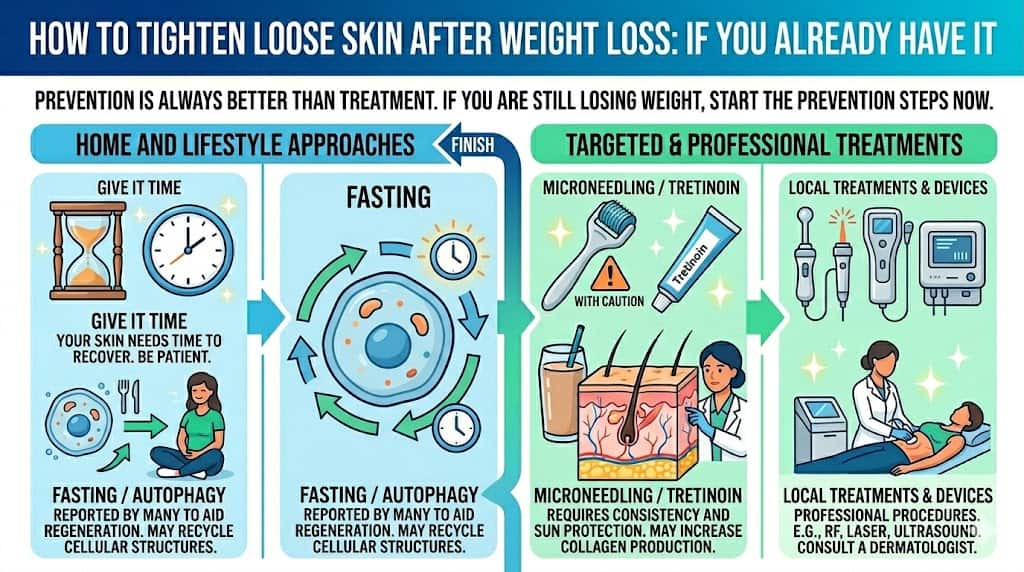
Part Two — How To Tighten Loose Skin After Weight Loss If You Already Have It
Prevention is always better than treatment. If you are still losing weight, these steps give your skin the best possible chance of keeping up with your body. How to avoid loose skin after losing weight starts before you finish — it starts now.
- Give It Time
- Fasting / Autophagy (reported by many):
- Microneedling / Tretinoin (with caution)
- Local Treatments & Devices:
Give It Two Years — The Most Underrated Advice on How To Tighten Loose Skin
Skin continues tightening for up to two years after you reach your goal weight. Most people do not give it anywhere near that long before they start panicking, spending money on treatments, or considering surgery.
Does loose skin tighten over time on its own? Yes — often significantly. Especially if you are younger, have better natural skin elasticity, are building muscle, and are eating enough protein. Give your body at least one to two years before drawing any conclusions about what you are actually dealing with.
Most people who ask how to tighten loose skin after weight loss are only a few months out from reaching their goal. That is far too early to judge. Keep doing the right things and give it time.
Fasting and Autophagy — How To Tighten Loose Skin After Weight Loss Naturally
Intermittent fasting and extended fasting trigger a cellular process called autophagy — where the body breaks down and recycles old damaged tissue, including loose skin cells. Many people who incorporated regular fasting into their routine after significant weight loss reported visible improvement in skin firmness over time.
16:8 intermittent fasting — eating within an 8 hour window and fasting for 16 hours — is the most practical starting point. It is low risk, sustainable, and has reported benefits beyond just loose skin including metabolic health improvements.
This is not an overnight solution. But as a long term addition to your approach on how to avoid loose skin after losing weight and improve existing loose skin, fasting is worth incorporating.
Microneedling and Tretinoin — Loose Skin After Weight Loss Treatment That Works
This combination has produced visible improvement in skin texture and firmness for many people dealing with loose skin after weight loss treatment.
Microneedling creates controlled micro-injuries in the skin that trigger collagen production as the skin heals. Tretinoin — a prescription retinoid — accelerates cell turnover and supports collagen synthesis. Used consistently over a year or more, the combination has shown real results in reducing the appearance of loose skin after weight loss.
This is not quick. It requires consistency over months. Tretinoin requires a prescription in most countries — consult a dermatologist before starting. But for people committed to a non-surgical loose skin after weight loss treatment approach, this combination is one of the most evidence-backed options available.
Clinical Treatments — Loose Skin After Weight Loss Treatment Options Worth Exploring
Several non-surgical clinical treatments have real evidence behind them for tightening loose skin after weight loss:
Radiofrequency treatments use heat energy to stimulate collagen production deep in the dermis. Multiple sessions are typically needed and results develop gradually over several months. This is one of the better-evidenced non-surgical loose skin after weight loss treatment options available.
Laser skin tightening uses targeted laser energy to tighten skin and stimulate collagen. Works best on mild to moderate loose skin and requires multiple sessions.
Infrared treatments and vibro-sculpt have been reported by some users to improve skin firmness and texture — particularly on stomach and thighs. Results vary significantly.
For clinical treatments, consult a qualified dermatologist or cosmetic physician rather than a spa or wellness center. Professional assessment of your specific situation will give you a realistic picture of what results are achievable for you.
What Does Not Work — Save Your Money
This needs to be said clearly because significant money gets wasted here every year.
Topical firming creams — the kind sold in pharmacies and marketed specifically for loose skin — do not produce meaningful results. Skin is a barrier. The active ingredients in most firming creams do not penetrate deep enough to affect the collagen layer in the dermis where tightening actually happens.
Basic moisturizing is worthwhile for skin health and hydration. But expensive creams marketed as solutions for how to tighten loose skin after weight loss are largely a waste of money. One widely shared piece of advice from experienced weight loss communities says it plainly — do not buy products for your skin. They do not help.
The exception is retinol and prescription tretinoin — both have real evidence at appropriate concentrations, especially tretinoin under medical guidance.
Can You Tighten Loose Skin Without Surgery — Compression Garments
While working on longer term improvement, compression garments are a practical daily management tool. They provide support, reduce the visible appearance of loose skin under clothing, and can significantly improve how you feel while your body continues to change over time.
Can you tighten loose skin without surgery? For mild to moderate cases — yes, through the combination of strength training, protein, clinical treatments, and time. Compression garments help manage the appearance in the meantime while those approaches do their work.
Surgery — When Nothing Else Is Enough
For people with significant loose skin after major weight loss — particularly after losing 100 pounds or more — non-surgical options may not get you where you want to be. In those cases, surgery is the only definitive answer to how to tighten loose skin after weight loss completely.
Loose skin removal surgery physically removes the excess skin. Results are immediate and permanent. The main considerations are cost and scarring — surgery trades loose skin for surgical scars, which for most people dealing with significant excess skin is a worthwhile trade.
Costs range from 10,000 to 30,000 dollars or more depending on the extent of the procedure and location. Some insurance providers cover loose skin removal surgery if it causes documented medical problems such as skin infections or rashes. Check your coverage before assuming it is entirely out of pocket.
Make sure your weight has been stable for at least 6 to 12 months before pursuing surgery. Operating on a body that is still changing is not advisable. Consult a board-certified plastic surgeon and get multiple assessments before making any decisions.
Does Loose Skin Tighten Over Time — Realistic Expectations
Does loose skin tighten over time? Here is the honest breakdown:
Minor loose skin in a younger person who lost weight gradually with strength training — very likely to improve significantly or resolve completely over 1 to 2 years.
Moderate loose skin with consistent muscle building, good protein intake, and clinical treatments — will improve meaningfully. May not fully resolve but can improve enough that surgery feels unnecessary.
Significant loose skin after major rapid weight loss in an older person — will improve somewhat with the right approach but is unlikely to fully resolve without surgery.
The approach is the same regardless of severity. Build muscle. Eat protein. Give it time. Use clinical treatments if needed. Consider surgery only after exhausting non-surgical options and giving your body proper time to respond.
Frequently Asked Questions
Q1. How to tighten loose skin after weight loss naturally?
Strength training is the most effective natural method — building muscle fills the space left by fat and gives skin something to sit against. Combined with high protein intake, collagen supplements, proper hydration, consistent skin care, and intermittent fasting, most people see meaningful improvement over 1 to 2 years without medical intervention.
Q2. How to avoid loose skin after losing weight?
Lose weight slowly at 1 to 2 pounds per week maximum. Do compound strength training throughout your weight loss journey. Eat adequate protein at every meal. Stay well hydrated. These four steps are the most evidence-backed ways to avoid loose skin after losing weight before it becomes a problem.
Q3. Does loose skin tighten over time without treatment?
Yes — skin continues tightening for up to 2 years after reaching goal weight. Minor loose skin in younger people with good genetics often improves significantly without any intervention. Does loose skin tighten over time for everyone? Not always completely — but giving it proper time before pursuing treatments or surgery is always the right first step.
Q4. Can you tighten loose skin without surgery?
Yes in many cases — especially for mild to moderate loose skin. Strength training, protein and collagen intake, microneedling with tretinoin, and clinical treatments like radiofrequency and laser have all shown real results. Can you tighten loose skin without surgery for severe cases after major weight loss? Possibly not completely — surgery may be necessary for significant excess skin.
Q5. How to prevent loose skin during weight loss?
Slow your weight loss pace to 1 to 2 pounds per week. Add compound strength training. Keep protein intake high throughout. These three steps are the most practical and evidence-backed answer to how to prevent loose skin during weight loss before it becomes an issue.
Q6. What is the best loose skin after weight loss treatment?
For natural methods — strength training and high protein diet. For clinical loose skin after weight loss treatment — radiofrequency, laser skin tightening, and microneedling with tretinoin. For severe cases — surgery. The right treatment depends on how much loose skin is present, how long it has been there, your age, and your goals.
Q7. How long does it take for loose skin to tighten after weight loss?
Skin continues tightening for up to 2 years after reaching the goal weight. Minor cases often see significant improvement within 12 months with proper nutrition and strength training. More significant loose skin takes longer and may require clinical treatment alongside natural approaches to see meaningful results.
For a full understanding of why loose skin happens and what mistakes make it worse, read our guide on Loose Skin After Weight Loss — Causes and Mistakes.
For women dealing with breast changes after weight loss, read our dedicated guide: [How to Fix Sagging Breasts After Weight Loss — What Actually Works]
For your complete weight loss plan, visit our Complete Weight Loss Guide.
Disclaimer:
The information in this article is for educational purposes only and does not constitute medical advice. Always consult a qualified healthcare professional before starting any treatment, supplement, or considering surgery for loose skin after weight loss.
Sources
- Bray, G.A. et al. (2016) — Alcohol consumption and body weight. Obesity Reviews. https://doi.org/10.1111/obr.12393
- Proksch, E. et al. (2014) — Oral collagen peptides improve skin elasticity and hydration. Skin Pharmacology and Physiology. https://doi.org/10.1159/000351376
- Calder, P.C. et al. (2017) — Protein intake and muscle preservation during caloric restriction. British Journal of Nutrition. https://doi.org/10.1017/S0007114517000752
- Alexiades, M. et al. (2012) — Radiofrequency treatment for skin tightening. Journal of Drugs in Dermatology. https://pubmed.ncbi.nlm.nih.gov/22506534/
- Bhatt, D.L. et al. (2018) — Intermittent fasting and autophagy — cellular repair mechanisms. New England Journal of Medicine. https://doi.org/10.1056/NEJMra1905136
- Leyden, J.J. et al. (2017) — Tretinoin and collagen synthesis — evidence review. Journal of the American Academy of Dermatology. https://doi.org/10.1016/j.jaad.2017.01.035

Robert Harisson
ISSA Certified Personal Trainer | Nutrition Specialist (Cornell University)
Robert Harrison is an ISSA-certified personal trainer and a nutrition graduate from Cornell University. With over five years of fitness coaching and two years of health-blog writing, he specializes in metabolism, women’s health, weight management, and natural wellness. Robert creates simple, science-backed content that helps readers make safe and informed decisions. His work reflects strong E-E-A-T principles, combining real-world coaching experience with evidence-based nutrition knowledge.