





You sit down for dinner with friends. Everyone orders the same meal. You finish yours, consider a second plate, and still find yourself raiding the kitchen two hours later. Meanwhile, your friend is still working through their first portion.
Or maybe this is more familiar. You have been the same weight for years regardless of what you eat. People joke that you have a hollow leg. You feel warm when everyone else reaches for a sweater. You have more energy than you know what to do with — but skip one meal and you hit a wall hard.
These are not random quirks. These are textbook fast metabolism signs, and if several of them sound like your everyday life, you are in the right place.
In this article you will learn:
- The 12 most reliable Fast Metabolism Symptoms — including the signs of high metabolism most people overlook
- How to know if you have a fast metabolism using a simple self-check
- What causes a high metabolic rate
- Whether a fast metabolism is actually good or bad
- How to properly support your body so it works at its best
No complicated science. No fluff. Direct answers to the questions you actually came here with.
What Is a Fast Metabolism? (And What Does It Actually Mean)
Before getting into the signs, it helps to understand what a fast metabolism actually is — because a lot of people use the term without knowing what is happening inside the body.
Your metabolism is the sum of every chemical process your body runs to keep you alive. Breathing, pumping blood, digesting food, repairing cells, maintaining body temperature — every one of these functions burns energy. Your body pulls that energy from the food you eat, every hour of every day, including while you sleep.¹
The speed at which your body burns through that energy is called your metabolic rate. Your resting metabolic rate — also called your Basal Metabolic Rate or BMR — is the number of calories your body burns just to keep itself running when you are completely at rest and doing nothing at all.²
When someone has a fast metabolism, their BMR is above average. Their body burns more calories at rest than most people of the same age, height, and weight would. Think of it like a car engine that runs at a higher RPM even when the car is parked — working harder, burning more fuel, generating more heat, even when it has nowhere to go.³
You cannot see this in a mirror. But you can absolutely feel it. And once you know what signs to look for, recognizing a high metabolic rate becomes surprisingly straightforward.
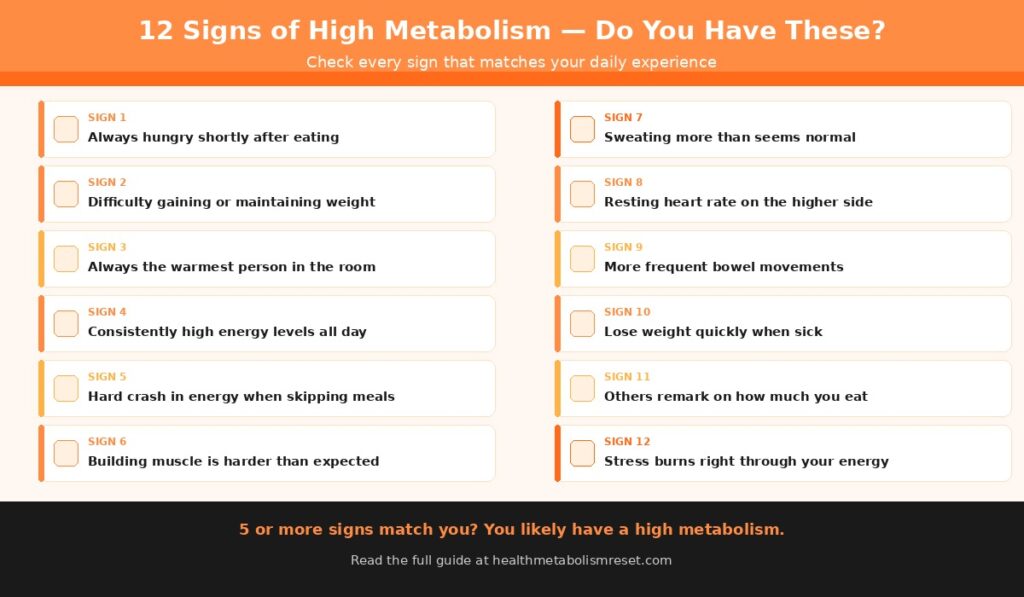
12 Fast Metabolism Symptoms to Watch For
These are the patterns that show up consistently in people with a genuinely elevated metabolic rate. These are the signs of a fast metabolism and signs of a high metabolism that are most reliable when self-assessing. Go through each one and be honest about how many match your experience.
1. You Are Always Hungry Even Shortly After Eating, The – Most Common Fast Metabolism Symptom
If there is one sign that almost every person with fast metabolism recognizes immediately, it is this one.
You eat a proper meal — not a snack, a full plate of food — and two hours later your stomach is growling again. You are standing in front of the fridge genuinely confused about how that is possible.
Here is what is happening. Your body burns through the energy from that meal faster than the average person does. The glucose in your bloodstream gets used up quickly, your energy reserves start to dip, and your brain sends out hunger signals well before most people would experience them.⁴
This is not a lack of willpower. It is your body doing exactly what it is designed to do — just at a considerably faster pace. People around you may assume you are eating out of boredom, but for someone with a high metabolic rate, the hunger is real, physical, and impossible to simply ignore.
2. Gaining Weight Feels Almost Impossible
This is one of the most commonly associated signs of high metabolism and fast metabolism signs — and one of the most misunderstood.
The world is full of advice about losing weight. Almost none of it addresses the opposite challenge. But for people with a fast metabolism, trying to gain weight is a genuine struggle that can feel just as frustrating as the reverse.
When your body burns calories faster than average, very little is left over to store as fat. You can eat large portions, add calorie-dense snacks, choose heavier foods — and still find yourself hovering at the same weight or even losing a little when life gets busy.⁵
Being chronically underweight carries real health risks including nutrient deficiencies, low bone density, hormonal disruption, and difficulty building muscle and strength long term.
3. You Are Always the Warmest Person in the Room
Does your partner steal all the blankets while you kick them off? Do you open windows in winter while everyone else wraps up? Are you the person at the office who is always slightly too warm regardless of the season?
A fast metabolism generates heat as a direct byproduct of burning energy. Your body produces more heat than average on a continuous basis, and that excess warmth has to go somewhere. These are among the most recognizable signs of high metabolism — people with these high metabolism symptoms tend to feel consistently warmer than those around them, sweat more easily, and genuinely prefer cooler temperatures.⁶
This is not just a personal preference. It is a measurable physical effect of running your internal engine at a higher speed around the clock.
4. Your Energy Levels Are Consistently High
People with fast metabolism — and these are some of the most overlooked Fast Metabolism Symptoms— often describe a baseline level of energy and alertness that others find impressive — or exhausting to be around. You might find it difficult to sit still for long periods. You may feel restless after a day of low activity. You might simply need less downtime than the people around you and find yourself ready to go again before everyone else has recovered.
This is your metabolism doing its job efficiently — converting food into energy at a rapid and consistent pace.⁷ The challenge is that this energy needs somewhere to go. People with a high metabolic rate who have sedentary jobs or lifestyles often experience it as restlessness, difficulty winding down at night, or a low-level physical impatience that is hard to explain to others.
5. You Crash Hard When You Skip a Meal
This one surprises people. You would expect someone with high energy to handle a missed meal easily. In reality, the opposite is true for most people with fast metabolism.
Because your body burns through its fuel reserves quickly, it does not have a large buffer to draw from when food is delayed. Most people can go four or five hours between meals and feel only mildly hungry. For someone with a high metabolic rate, skipping a meal can mean going from feeling completely fine to feeling headachy, irritable, foggy, and physically weak in what feels like a very short window.⁸
If you have ever been described as hangry — or noticed that your mood and focus drop dramatically when you have not eaten for a few hours — your metabolism burning through its reserves faster than expected is very likely why.
6. Building Muscle Is Harder Than You Expected
You go to the gym consistently. You lift heavier over time. You follow a solid program. But the muscle gains come slowly and do not match what your training partners are achieving on the same routine.
A fast metabolism burns through everything — not just fat, but also the extra calories and protein your body needs to build and repair muscle tissue after training.⁹ If your body is already running at a high calorie burn, it has very little left over to dedicate to muscle synthesis unless you are eating significantly above your already elevated maintenance level.
This does not make building muscle impossible. It just means the nutritional margin for error is much smaller.
7. You Sweat More Than Seems Normal
Even during light activity — a brisk walk, carrying bags, standing in a warm room — you notice yourself sweating before others do. Exercise that leaves your friends lightly glowing leaves you thoroughly drenched. Excessive sweating during light activity is one of the lesser-discussed fast metabolism signs, but it shows up consistently.
This connects directly to the heat generation that accompanies high metabolism symptoms. Your body produces more heat and has to work harder to cool itself down. Sweating is the primary mechanism your body uses for cooling. It is not a fitness issue or a hygiene concern — it is simply your body’s cooling system working overtime to keep pace with an internal engine that runs hotter than average.¹⁰
8. Higher Resting Heart Rate — Sign of Fast Metabolism
Your resting heart rate is the number of times your heart beats per minute when you are calm and still. The typical adult range is 60 to 100 beats per minute, with well-trained athletes often sitting lower.¹¹
For people with fast metabolism, the resting heart rate can consistently sit toward the higher end of the normal range. Your heart is working to support a body that is constantly processing and burning energy, and that ongoing activity keeps the cardiovascular system more active than in someone running at a slower pace.
Important: If your resting heart rate is elevated and accompanied by sudden unexplained weight loss, anxiety, tremors, or a sensation of your heart racing at odd moments, speak to a doctor to check your thyroid levels. An overactive thyroid produces similar high metabolism symptoms — sometimes called hyperactive metabolism or symptoms of hypermetabolism — but at a more extreme and clinical level that requires medical attention.¹²
9. Frequent Bowel Movements — Fast Metabolism Digestive Sign
Not the most glamorous sign, but one of the most consistent. When your digestive system is moving quickly, food passes through your gut faster than average. People with a fast metabolic rate often have bowel movements more frequently than the people around them and may notice their digestion kicks into gear very soon after eating.¹³ It is worth noting that high metabolism symptoms in men and women are largely the same in this area, though men may notice the frequency difference more acutely given typical dietary volume differences.
This is simply your body processing and moving things along at an accelerated rate. In most cases it is entirely normal — just noticeably faster than typical.
10. You Lose Weight Quickly When You Are Sick
Being sick is hard on everyone. But people with fast metabolism often notice that even a few days of illness leads to visible weight loss that takes a while to recover.
Your immune system is extremely energy-hungry when it is actively fighting infection. If your body was already burning calories at a high rate before the illness arrived, the combined demand can rapidly deplete your reserves.¹⁴ Recovery often requires eating more than expected, and people with a high metabolism may find that getting back to their normal weight after illness takes deliberate effort and time.
11. People Consistently Remark on How Much You Eat
If multiple people across your lifetime have commented on how much you eat, how you never seem to gain weight despite eating generously, or how you always seem to be hungry — pay attention to that pattern.
Friends, family members, partners, coworkers. If it keeps coming up from different people over years, your metabolism is doing something genuinely different from the average person around you. Outside observers who see you regularly are noticing something real.
12. Stress Amplifies Fast Metabolism Symptoms
During difficult periods at work or in life, you might notice that you lose weight without trying, feel more physically depleted than the situation warrants, or need to eat significantly more just to maintain your baseline energy levels.
Stress hormones like cortisol and adrenaline temporarily increase your metabolic rate. For someone who is already running fast, this additional push can tip the balance noticeably.¹⁵ You might feel simultaneously wired and exhausted, or find that your appetite becomes unpredictable during periods of pressure. Your body is simply burning through resources faster than it normally would — and a fast metabolism amplifies that effect.
How to Know If You Have a Fast Metabolism — Your Personal Self-Check
Knowing how to know if you have a fast metabolism comes down to recognizing physical signs in your daily life and understanding your eating and weight patterns over time. The signs of high metabolism below are the same ones doctors use as initial screening indicators before ordering clinical tests.
Here is a straightforward self-check. Answer each question honestly based on your regular, everyday experience — not your best or worst days.
Do you feel hungry again within two to three hours of eating a full meal?
Have you struggled to gain or maintain weight for most of your life?
Do you feel noticeably warmer than others in the same environment?
Do you have consistently high energy that sometimes makes it hard to wind down?
Do you crash hard in mood, focus, or energy when you skip a meal?
Do you sweat more than others during light physical activity?
Have you struggled to build muscle despite consistent training?
Do you have frequent bowel movements compared to most people you know?
Have multiple people commented on how much you eat relative to your size?
Do you lose weight noticeably during periods of illness or high stress?
Scoring:
- 5 or more yes answers: You very likely have a high metabolic rate
- 7 or more yes answers: You almost certainly do
For a definitive answer, a doctor can measure your BMR directly or run a thyroid panel to rule out any medical causes driving the elevated rate. But the pattern above is a strong and reliable indicator on its own.¹⁶
What Causes Fast Metabolism?
Understanding what drives a fast metabolic rate helps you work with your body rather than against it.
Genetics is the single biggest factor and the one you have the least control over. Your genes determine how efficiently your cells produce energy, how your hormones regulate fuel burning, and your baseline cellular activity levels.¹⁷ If your parents or grandparents showed signs of high metabolism — constant hunger, difficulty gaining weight, high natural body temperature — there is a very strong chance yours runs fast too. It is the body you were born into.
Lean muscle mass plays a significant role because muscle tissue burns considerably more calories at rest than fat tissue does.¹⁸ People who carry more lean muscle naturally have a higher resting metabolic rate — which is one of the few lifestyle factors that can meaningfully influence your baseline calorie burn over time, and why strength training has long-term metabolic benefits beyond just appearance.
Age affects everyone’s metabolic rate over time. Metabolism tends to be fastest during childhood and adolescence when the body is growing rapidly. It gradually slows through adulthood, with more noticeable changes often appearing in the mid-thirties and beyond.¹⁹ If you have always had a high metabolism, you may notice it gently cooling as you get older — which is entirely normal.
Thyroid function deserves its own mention because it is separate from a naturally fast metabolism. Your thyroid gland produces hormones that directly regulate how fast your cells burn energy. An overactive thyroid — called hyperthyroidism — forces your body to run at an artificially elevated metabolic rate. The key distinction is that hyperthyroidism tends to cause more severe and sudden symptoms including rapid and irregular heartbeat, significant unintended weight loss, anxiety, tremors, and pronounced heat intolerance.²⁰ It is a medical condition that requires treatment. If your symptoms feel extreme or came on suddenly, see a doctor.
Physical activity level shapes your metabolic rate more than most people realize. Regular exercise — particularly strength training — increases your metabolic rate both during the activity and for hours afterward as your body recovers and repairs.²¹ Consistently active people often develop a faster resting metabolic rate over time.
Body composition ties back to the muscle mass point. Two people can weigh exactly the same on a scale and have dramatically different metabolic rates based on the ratio of muscle to fat in their bodies.²²
Signs Your Metabolism Is Speeding Up
Sometimes a metabolism is not always fast but is increasing or shifting higher. Knowing the signs your metabolism is speeding up helps you understand what your body is going through — and whether it needs attention.
Watch for these fast metabolism signs and high metabolism symptoms that indicate your rate is accelerating:
- You are suddenly hungrier than usual even though your lifestyle has not changed
- You are losing weight without any change in diet or exercise habits
- You feel warmer or flush more easily than you used to
- Your heart rate feels higher than your personal baseline
- Your bowel movements have become more frequent than your usual pattern
- You are having more trouble sleeping or feel unusually wired at night
- You are sweating during activities that did not used to cause it
If these signs your metabolism is speeding up are gradual and mild, they may simply reflect a natural shift in your activity level or body composition. If they are sudden, significant, or accompanied by anxiety, heart palpitations, or tremors — get your thyroid levels checked promptly. A sudden and unexplained increase in your metabolic rate is worth investigating with a doctor.²³
Is a High Metabolism Good or Bad?
This is one of the most searched questions on this topic, and it deserves a direct and honest answer.
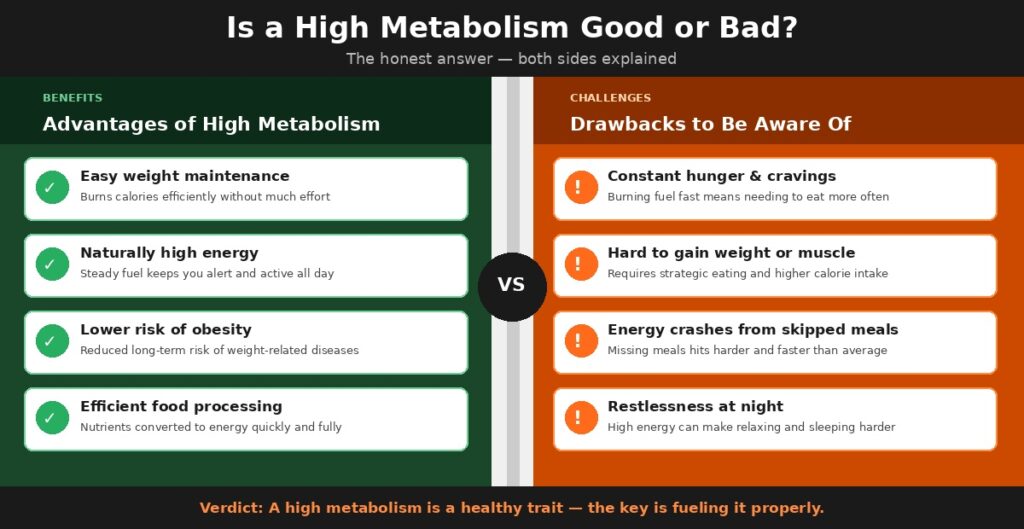
Whether a high metabolism is good or bad depends largely on how well you support it with nutrition and lifestyle. In itself, a naturally fast metabolic rate is generally a positive and healthy trait.
The genuine advantages are significant. Maintaining a healthy body weight is easier when your body burns calories efficiently. You are far less likely to accumulate excess body fat under normal eating conditions. Your energy levels tend to be naturally higher. Your body processes food and nutrients effectively. Long term, these factors reduce your risk of obesity-related conditions including type 2 diabetes, cardiovascular disease, and metabolic syndrome.²⁴
But the challenges deserve equal honesty. Gaining weight when you genuinely need to — during pregnancy, recovery from illness, or muscle-building phases — is difficult and requires deliberate effort. Eating enough to maintain your weight is a constant responsibility that most people never have to think about. The hunger that comes with high metabolism symptoms is inconvenient, expensive, and sometimes socially awkward. Energy crashes from missed meals can disrupt your entire day. Building the body composition you want takes more strategic nutritional effort.
The honest conclusion: A naturally high metabolism is a healthy trait that works in your favor in most circumstances. Whether you are experiencing higher metabolism symptoms for the first time or recognizing signs your metabolism has sped up over recent months, the key is meeting its demands consistently — enough food, the right balance of nutrients, and a lifestyle that matches your body’s pace. Problems arise not from having fast metabolism, but from failing to fuel it properly.
How to Support a High Metabolism the Right Way
The goal is not to slow your metabolism down. The goal is to give it what it needs so your body can function at its absolute best without running on empty. If you are here because you noticed signs of metabolism speeding up recently, or because you simply want to maintain the signs of good metabolism you already have, the principles below apply equally.
Eat more frequently throughout the day. Three meals a day is often simply not enough for someone with a fast metabolic rate. Aim for four to six eating occasions spread evenly throughout the day. This keeps your blood sugar stable, prevents the energy crashes that come from going too long without fuel, and ensures your body always has something to burn without pulling from muscle tissue.²⁵
Make protein the centerpiece of every meal. Protein supports muscle maintenance and repair — critical when your body is burning through resources quickly. It also has a higher thermic effect than carbohydrates or fat, meaning your body burns more energy just processing it.²⁶ Include a quality protein source at every single meal and snack without exception.
Never skip meals. For most people, skipping a meal is a minor inconvenience. For someone with fast metabolism, it can mean genuine consequences for energy, mood, mental focus, and muscle tissue. Your body burns through its reserves faster than average and does not carry a large buffer. Feed it on a consistent schedule.
Lift weights regularly. Strength training builds and maintains the muscle mass that supports a healthy body composition even when your body burns calories quickly. It also creates a recovery demand that requires your body to use extra calories for repair — one of the rare circumstances where a high metabolism works in your favor for muscle building, provided you eat enough to support it.²⁷
Choose calorie-dense, nutrient-rich foods. Filling up on large volumes of low-calorie foods does not work well for people with high metabolism symptoms. Focus on foods that pack real nutritional value into a manageable amount of food. Nuts, nut butters, avocados, whole grains, eggs, fatty fish, legumes, full-fat dairy, and quality oils help you meet your caloric needs without having to eat an overwhelming volume at every sitting.²⁸
Stay consistently hydrated. A fast metabolism uses more water because it generates more heat and runs more internal processes simultaneously. Mild dehydration can impair metabolic function and make you feel worse than you should. Keep water intake high throughout the entire day, not just during exercise.²⁹
Track your food intake if you are struggling. If you are losing weight unintentionally or finding it difficult to maintain your weight, use a food tracking app for a week or two to see what you are actually consuming versus what your body genuinely needs. Most people with fast metabolism are surprised to discover they are eating less than they thought once they measure it accurately.
Frequently Asked Questions
What are the signs of fast metabolism?
The most common signs of fast metabolism are constant hunger even after full meals, difficulty gaining or maintaining weight, feeling warmer than others in the same environment, consistently high energy levels, sweating easily during light activity, hard energy crashes when meals are skipped, difficulty building muscle despite regular training, and frequent bowel movements. If five or more of these match your daily experience, your metabolic rate is very likely above average.
What are the high metabolism symptoms?
High metabolism symptoms include persistent hunger throughout the day, inability to gain weight despite eating generously, elevated body temperature compared to those around you, high natural energy levels, a resting heart rate toward the upper end of the normal range, frequent and fast digestion, sweating during light physical activity, and energy crashes between meals. These symptoms of high metabolism are consistent and show up across most people with a genuinely elevated metabolic rate.
How to know if you have a fast metabolism?
To know if you have a fast metabolism, go through the 12 signs and self-check questions in this article honestly. If five or more signs match your regular daily experience — particularly constant hunger, difficulty gaining weight, high energy, and feeling warmer than others — you very likely have a high metabolism. A doctor can confirm with a BMR measurement or a thyroid hormone panel checking TSH, T3, and T4 levels
How do I know if I have a fast metabolism?
Check how many of the 12 signs in this article apply to your everyday life. Constant hunger within a few hours of eating, struggling to gain weight, feeling consistently warmer than others, and crashing hard when you skip meals are the strongest individual indicators. If five or more apply to you regularly, your metabolic rate is very likely above average. A doctor can run a clinical BMR measurement or thyroid panel to confirm.
What are the signs your metabolism is speeding up?
The signs your metabolism is speeding up include sudden increased hunger without any change in your activity level, unexplained weight loss, feeling warmer or flushing more easily than before, a higher resting heart rate than your personal baseline, more frequent bowel movements than your usual pattern, and disrupted sleep or feeling unusually wired at night. If these changes are sudden and significant rather than gradual, get your thyroid levels checked with a doctor.
Is a high metabolism good or bad?
A high metabolism is generally a positive and healthy trait. It makes maintaining a healthy weight significantly easier, supports naturally higher energy levels, and reduces the long-term risk of obesity-related health conditions including type 2 diabetes and cardiovascular disease. The main challenges are difficulty gaining weight and muscle when needed, constant hunger, and energy crashes from missed meals. With the right nutritional approach — more frequent meals, higher protein, calorie-dense foods — these challenges are manageable and the benefits outweigh the drawbacks for most people.
What does a fast metabolism mean?
A fast metabolism means your body burns calories at a rate that is above average for your age, height, and weight — even when you are completely at rest. Your BMR is higher than typical, which means you need more food to maintain your weight and energy levels than most people of a similar size and age would require.
What causes fast metabolism?
Fast metabolism is caused primarily by genetics, which accounts for the largest share of natural variation in metabolic rate. High lean muscle mass, regular physical activity especially strength training, younger age, and thyroid hormone levels all play significant roles as well. An overactive thyroid — hyperthyroidism — can also cause an artificially elevated metabolic rate and requires medical evaluation and treatment.
What causes high metabolism specifically in some people?
What causes high metabolism to run faster in certain individuals comes down to a combination of inherited genetic factors, naturally higher lean muscle mass, hormonal differences especially in thyroid function, and consistent physical activity over time. People who have always had a fast metabolism typically have a genetic predisposition that causes their cells to produce and burn energy at a higher baseline rate than average, regardless of diet or lifestyle.
How do you tell if you have a fast metabolism?
You can tell if you have a fast metabolism by consistently experiencing several of the following: finishing meals quickly and feeling hungry again within two to three hours, struggling to gain weight despite eating generously, feeling warmer than the people around you in the same environment, having high natural energy levels, crashing hard when you skip meals, and sweating easily during light physical activity. Five or more of these applying to you regularly is a reliable indicator of a high metabolic rate.
Do people with high metabolism get hungry faster?
Yes. People with high metabolism get hungry faster because their bodies burn through the energy from meals more quickly than average. Glucose from food is metabolized at a faster rate, energy reserves drop sooner, and the brain sends hunger signals well before most people of the same size and age would experience them. This is one of the most consistent and recognizable signs of fast metabolism in daily life.
How to know if my metabolism is fast?
The most reliable way to know if your metabolism is fast is to check how many of the 12 symptoms in this article match your daily experience…
What are signs of fast metabolism in daily life?
The signs of fast metabolism you notice most in daily life are finishing meals quickly and feeling hungry again within two hours…
Related Articles Worth Reading Next
- What Does a Fast Metabolism Mean? Full Explanation
- Benefits and Advantages of a High Metabolism
- Slow Metabolism Symptoms: How to Know If Your Metabolism Is Slow
- Fast Metabolism vs Slow Metabolism: Key Differences Explained
- Basal Metabolic Rate Explained: What Your BMR Means and How to Use It
- Metabolism Explained: Types, Rate & How to Boost
Disclaimer
This content is for informational purposes only and does not substitute professional medical advice. Always consult a qualified healthcare professional for personalized health guidance.
Sources & Inline Citations
¹ Cleveland Clinic. Metabolism: What It Is and How It Works. https://my.clevelandclinic.org/health/body/21893-metabolism
² National Institutes of Health (NIH). Metabolic Health Overview. https://www.ncbi.nlm.nih.gov/books/NBK537590/
³ Mayo Clinic. Metabolism and Weight Loss. https://www.mayoclinic.org/healthy-lifestyle/weight-loss/in-depth/metabolism/art-20046508
⁴ Harvard Health Publishing. The Truth About Metabolism. https://www.health.harvard.edu/staying-healthy/the-truth-about-metabolism
⁵ National Institute of Diabetes and Digestive and Kidney Diseases (NIDDK). Metabolism. https://www.niddk.nih.gov/health-information/weight-management/metabolism
⁶ Cleveland Clinic. Metabolism: What It Is and How It Works. https://my.clevelandclinic.org/health/body/21893-metabolism
⁷ Mayo Clinic. Metabolism and Weight Loss. https://www.mayoclinic.org/healthy-lifestyle/weight-loss/in-depth/metabolism/art-20046508
⁸ Harvard Health Publishing. The Truth About Metabolism. https://www.health.harvard.edu/staying-healthy/the-truth-about-metabolism
⁹ National Institutes of Health (NIH). Metabolic Health Overview. https://www.ncbi.nlm.nih.gov/books/NBK537590/
¹⁰ Cleveland Clinic. Metabolism: What It Is and How It Works. https://my.clevelandclinic.org/health/body/21893-metabolism
¹¹ Johns Hopkins Medicine. Metabolism and Digestive Health. https://www.hopkinsmedicine.org/health/wellness-and-prevention/metabolism-and-weight
¹² American Thyroid Association. Thyroid and Metabolism. https://www.thyroid.org/thyroid-and-metabolism/
¹³ Johns Hopkins Medicine. Metabolism and Digestive Health. https://www.hopkinsmedicine.org/health/wellness-and-prevention/metabolism-and-weight
¹⁴ National Institute of Diabetes and Digestive and Kidney Diseases (NIDDK). Metabolism. https://www.niddk.nih.gov/health-information/weight-management/metabolism
¹⁵ Endocrine Society. Metabolism and Hormonal Health. https://www.endocrine.org/patient-engagement/endocrine-library/metabolism
¹⁶ Mayo Clinic. Metabolism and Weight Loss. https://www.mayoclinic.org/healthy-lifestyle/weight-loss/in-depth/metabolism/art-20046508
¹⁷ Harvard Health Publishing. The Truth About Metabolism. https://www.health.harvard.edu/staying-healthy/the-truth-about-metabolism
¹⁸ National Institutes of Health (NIH). Metabolic Health Overview. https://www.ncbi.nlm.nih.gov/books/NBK537590/
¹⁹ Mayo Clinic. Metabolism and Weight Loss. https://www.mayoclinic.org/healthy-lifestyle/weight-loss/in-depth/metabolism/art-20046508
²⁰ American Thyroid Association. Thyroid and Metabolism. https://www.thyroid.org/thyroid-and-metabolism/
²¹ World Health Organization (WHO). Healthy Diet and Energy Balance. https://www.who.int/news-room/fact-sheets/detail/healthy-diet
²² National Institutes of Health (NIH). Metabolic Health Overview. https://www.ncbi.nlm.nih.gov/books/NBK537590/
²³ American Thyroid Association. Thyroid and Metabolism. https://www.thyroid.org/thyroid-and-metabolism/
²⁴ World Health Organization (WHO). Healthy Diet and Energy Balance. https://www.who.int/news-room/fact-sheets/detail/healthy-diet
²⁵ Harvard Health Publishing. The Truth About Metabolism. https://www.health.harvard.edu/staying-healthy/the-truth-about-metabolism
²⁶ National Institutes of Health (NIH). Metabolic Health Overview. https://www.ncbi.nlm.nih.gov/books/NBK537590/
²⁷ Mayo Clinic. Metabolism and Weight Loss. https://www.mayoclinic.org/healthy-lifestyle/weight-loss/in-depth/metabolism/art-20046508
²⁸ Johns Hopkins Medicine. Metabolism and Digestive Health. https://www.hopkinsmedicine.org/health/wellness-and-prevention/metabolism-and-weight
²⁹ Cleveland Clinic. Metabolism: What It Is and How It Works. https://my.clevelandclinic.org/health/body/21893-metabolism
Blog History
This article is regularly reviewed and updated by our medical research team to ensure accuracy, relevance, and evidence-based insights.
Posted On:
Last Updated:

Robert Harisson
ISSA Certified Personal Trainer | Nutrition Specialist (Cornell University)
Robert Harrison is an ISSA-certified personal trainer and a nutrition graduate from Cornell University. With over five years of fitness coaching and two years of health-blog writing, he specializes in metabolism, women’s health, weight management, and natural wellness. Robert creates simple, science-backed content that helps readers make safe and informed decisions. His work reflects strong E-E-A-T principles, combining real-world coaching experience with evidence-based nutrition knowledge.


It’s the best time to make some plans for the future and it is time to be happy.
I’ve read this post and if I could I desire to suggest you
some interesting things or advice. Perhaps you could write next articles referring to this article.
I want to read more things about it!