




You have probably heard the phrase a hundred times. Someone eats everything in sight without gaining a pound and someone says “oh, they just have a fast metabolism.” A friend complains that they cannot put on weight no matter what they try and the explanation is always the same three words: fast metabolism.
But what does fast metabolism mean, exactly? What is actually happening inside the body when someone has one? Is it something you are born with or something that changes? And if you have one, what are you supposed to do about it?
These are the questions this guide answers. By the time you finish reading, you will have a clear, complete understanding of what fast metabolism means, what causes it, how it shows up in real life, and how to work with it rather than against it.
What Does Fast Metabolism Mean?
Let us start with the definition of fast metabolism in the simplest possible terms.
A fast metabolism means your body’s idle speed is higher than average. Your body burns through calories more quickly than most people of the same age, height, and weight would. Even when you are sitting still, sleeping, or doing nothing at all, your body uses more energy than the average person’s.
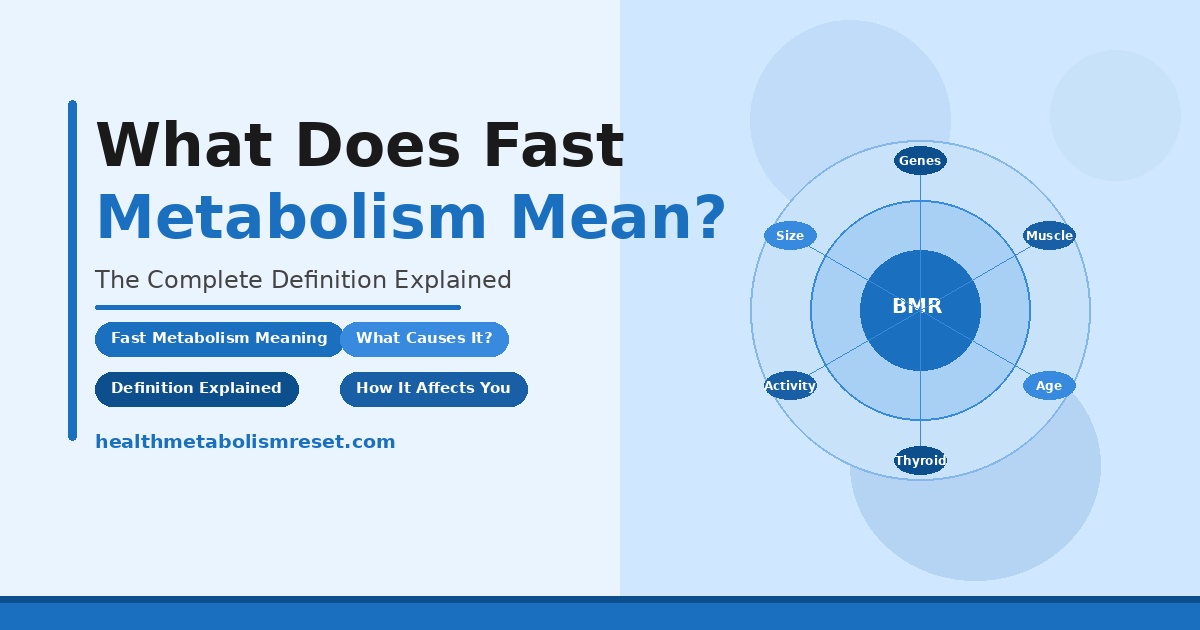
The technical measurement behind this is called your Basal Metabolic Rate, or BMR. Your BMR is the number of calories your body burns at complete rest just to keep your basic systems running — heart, lungs, brain, temperature regulation, cell repair. When someone has a fast metabolism, their BMR is above the average for their size and age.
Your metabolism is every chemical process your body uses to convert food into energy. Every breath you take, every heartbeat, every thought your brain processes, every movement your muscles make — all of it requires energy. Your body is continuously pulling that energy from the food you eat and the reserves it stores, running these processes around the clock without stopping.
Your metabolic rate is the speed at which your body runs all of these processes. Think of it like the idle speed of a car engine. Some engines idle higher than others, even when the car is parked and going nowhere. They burn more fuel just sitting still.
So, in simple terms, fast metabolism meaning comes down to this: your body is a faster, hungrier engine than most. It processes and burns fuel more quickly, needs more of it to keep running, and leaves very little left over to store as fat.
What Does Higher Metabolism Mean in Practice?
Understanding the definition is one thing. But what does higher metabolism mean when you are actually living with one day to day?
Here is what it looks like in real life.
You eat a full meal and feel satisfied. Then two hours later the hunger comes back, stronger than it has any right to be. You eat more than your friends at every meal but your weight stays stubbornly the same or even dips. You feel warm when everyone else is comfortable. You have energy to burn but when you skip a meal you crash hard and fast.
This is what higher metabolism means in practice. It means your body is constantly running a faster program than the people around you. The food you eat gets processed and used up more quickly. Your reserves get drawn down faster. Your hunger signals fire sooner. Your body generates more heat as a byproduct of burning more energy.
For some people this feels like a gift. Staying lean is effortless. Energy levels are naturally high. The body feels efficient and responsive. For others it feels like a burden — always hungry, always needing to eat, struggling to put on the weight or muscle they want, feeling like their body is working against them at every turn.
Both experiences are valid. And both come from the same underlying reality: a metabolic rate that runs faster than average.
The Definition of Fast Metabolism: Breaking It Down
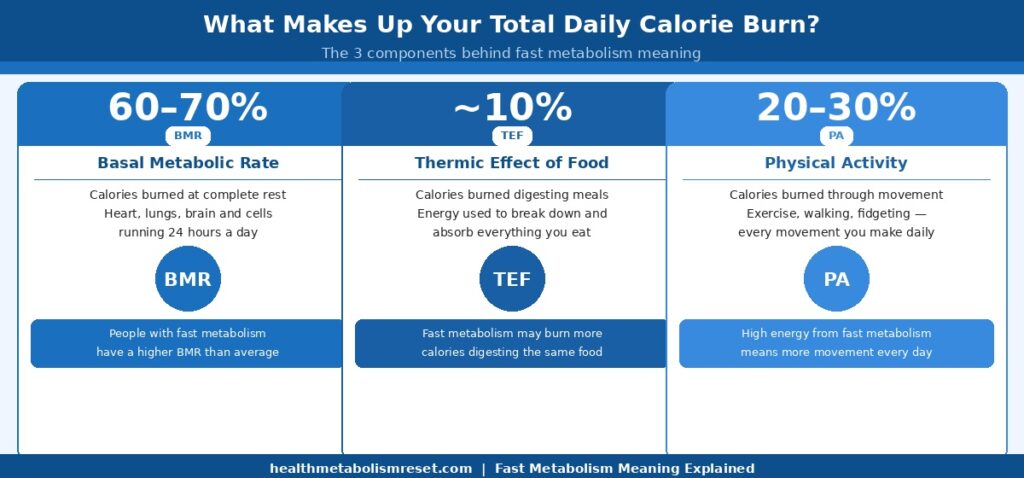
To fully understand the definition of fast metabolism, it helps to understand the three components that make up your total daily calorie burn.
Basal Metabolic Rate (BMR) is the largest component, typically accounting for 60 to 70 percent of the total calories you burn each day. This is the energy your body uses at complete rest. When people talk about someone having a naturally fast metabolism, they are almost always talking about a higher-than-average BMR. Your body simply burns more calories doing nothing.
Thermic Effect of Food (TEF) is the energy your body uses to digest, absorb, and process the food you eat. This accounts for roughly 10 percent of your daily calorie burn. People with a fast metabolism may have a slightly higher thermic effect, meaning they burn more calories in the process of digesting the same meal than the average person would.
Physical Activity covers everything from formal exercise to simply fidgeting and moving around throughout the day. People with a naturally fast metabolism often have more energy and tend to move more, which adds to their overall daily calorie burn beyond just the resting rate.
When all three of these are running faster than average, the result is a total daily calorie burn that is significantly higher than what most people experience. This is the complete picture behind what fast metabolism means.
What Causes a Fast Metabolism?
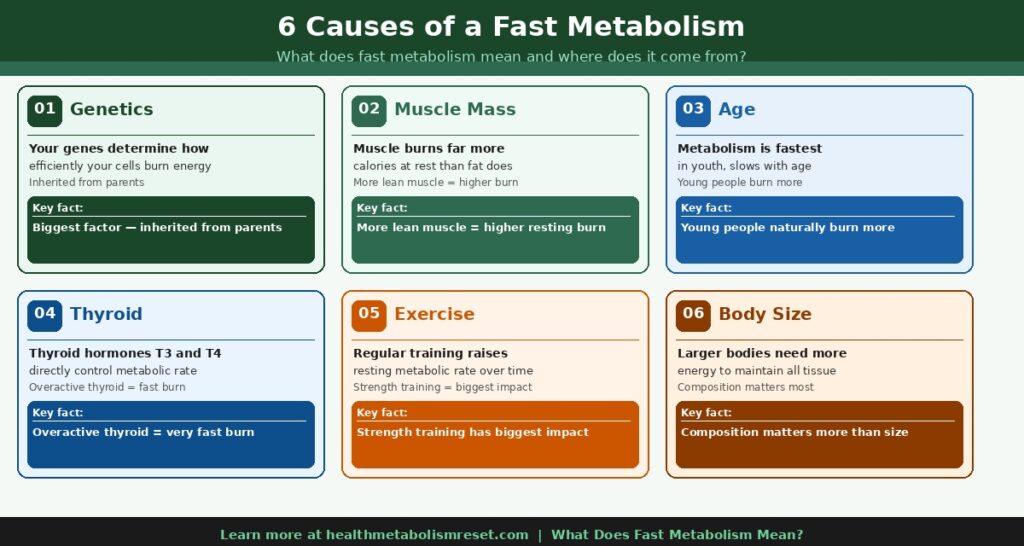
Now that the meaning of fast metabolism is clear, the obvious next question is: where does it come from? Why do some people have a faster metabolic rate than others?
- Genetics is the primary cause.
- Muscle mass is the second biggest factor.
- Age plays a significant role over time.
- Hormones, particularly thyroid hormones, directly regulate metabolic rate.
- Regular physical activity raises your metabolic rate over time.
- Body size matters too
READ ABOUT – SLOW METABOLISM
What Does Faster Metabolism Mean Compared to Average?
To put this in concrete terms, what does faster metabolism mean when you actually measure it?
The average resting metabolic rate for an adult woman is roughly 1,400 to 1,600 calories per day. For an adult man it is typically 1,600 to 1,800 calories per day. These are the calories burned at complete rest, before any activity is added.
Someone with a genuinely fast metabolism might burn 200 to 400 more calories per day at rest than these averages suggest for their size and age. Over the course of a week, that is 1,400 to 2,800 additional calories burned just from having a higher idle rate. Over a month, that difference is substantial — which explains why people with a fast metabolism can eat considerably more than others without gaining weight.
Add in the higher activity levels that often accompany a fast metabolism and the total daily calorie burn can be dramatically above average. Some people with a genuinely high metabolic rate need 3,000 to 4,000 calories per day just to maintain their weight — more than double what a sedentary person of similar size would require.
This is not a superpower. It is a physiological reality that comes with its own demands and challenges. Meeting those demands requires consistent, deliberate effort around food and nutrition.
Fast Metabolism Meaning for Your Health
Understanding what fast metabolism means matters beyond just explaining why you are always hungry. Your metabolic rate affects almost every aspect of your physical health.
Weight management is the most obvious one. People with a fast metabolism find it significantly easier to stay lean and much harder to gain weight when they want or need to. This cuts both ways — being chronically underweight carries its own health risks including weakened immune function, hormonal disruption, low bone density, and difficulty building and maintaining the muscle mass your body needs to stay strong and healthy as you age.
Energy levels are directly tied to metabolic rate. A faster metabolism generally means more energy available throughout the day, which supports physical activity, mental clarity, and overall wellbeing. However, this only holds true when you are eating enough to match your metabolic demands. When intake falls short, the opposite happens — fatigue, brain fog, and mood drops become common.
Hunger and appetite are amplified by a fast metabolism. Your body sends hunger signals more frequently and more urgently than the average person experiences. This is not a character flaw or lack of discipline. It is your body accurately communicating its higher than average fuel needs.
Muscle building and body composition are influenced by metabolic rate in ways that many people do not realize. Because your body burns through calories and nutrients quickly, it has less available to dedicate to muscle repair and growth after exercise unless you are eating significantly above your already elevated maintenance level. People with a fast metabolism often need to eat more protein and more total calories than standard recommendations to achieve the same muscle-building results as someone with an average metabolic rate.
Temperature regulation is noticeably different. A faster metabolism generates more heat as a byproduct of higher calorie burning. People with a high metabolic rate tend to feel warmer than others in the same environment, sweat more easily, and are genuinely more comfortable in cooler temperatures.
How to Know If Fast Metabolism Meaning Applies to You
Reading a definition is useful. But how do you actually know whether you have a fast metabolism rather than just a big appetite or an active lifestyle?
The most reliable signs that the fast metabolism meaning applies to your life are these. You have always struggled to gain or maintain weight despite eating generously. You feel hungry again within two to three hours of a full meal, consistently and throughout your life. You feel noticeably warmer than people around you in the same environment. You have high energy levels that sometimes make it difficult to sit still or wind down. You experience hard and fast energy crashes when you miss a meal. Others have commented repeatedly on how much you eat relative to your size. You struggle to build muscle despite consistent training and eating well.
If most of these describe your experience and have done so for most of your life, not just during a particularly active phase, the fast metabolism meaning almost certainly applies to you.
For a clinical confirmation, a doctor can estimate your BMR or measure it directly, and can run thyroid function tests to rule out hyperthyroidism as an underlying cause of an elevated metabolic rate.
Frequently Asked Questions
What does fast metabolism mean?
Fast metabolism means your body burns calories at a rate that is above average for your age, height, and weight, even at rest. Your Basal Metabolic Rate is higher than typical, which means your body needs more food to maintain its weight and energy levels than most people of a similar size.
What does faster metabolism mean compared to normal?
A faster metabolism means your body processes and uses energy more quickly than the average person. You burn more calories at rest, feel hungry sooner after eating, generate more body heat, and have less left over to store as fat. In practical terms it means needing to eat more food more frequently to meet your body’s demands.
What is the definition of fast metabolism?
The definition of fast metabolism is a metabolic rate that is above average for a person of a given age, size, and sex. Specifically it means a higher Basal Metabolic Rate — the number of calories your body burns at rest to maintain basic functions. A person with a fast metabolism burns more calories doing nothing than the average person of the same size would.
What does high metabolism mean for weight?
High metabolism means maintaining a low body weight is easier and gaining weight is harder. Your body burns through calories quickly and stores very little as fat under normal eating conditions. For people trying to gain weight or build muscle, a high metabolism means needing to eat significantly more than standard recommendations to create the surplus required for growth.
Can you slow down a fast metabolism?
Your metabolic rate can be influenced but not dramatically changed in the short term. Eating less frequently, reducing physical activity, and losing muscle mass will gradually lower your metabolic rate over time. However, working against your natural metabolic rate is rarely productive. A better approach is to understand and support it with the right nutrition rather than trying to fight it.
Disclaimer
This content is for informational purposes only and does not substitute professional medical advice. Always consult a qualified healthcare professional for personalized health guidance.
Sources & Further Reading
[1] Healthline. What Is Basal Metabolic Rate? Medically reviewed by Imashi Fernando, MS, RDN. Updated May 5, 2023. Available at: https://www.healthline.com/health/what-is-basal-metabolic-rate
[2] Cleveland Clinic. Basal Metabolic Rate (BMR): What It Is and How to Calculate It. Last updated November 20, 2024. Available at: https://my.clevelandclinic.org/health/body/basal-metabolic-rate-bmr
[3] National Academies of Sciences. Factors Affecting Energy Expenditure and Requirements. Dietary Reference Intakes for Energy. NCBI Bookshelf. Available at: https://www.ncbi.nlm.nih.gov/books/NBK591031/
[4] Calcagno M, et al. The Thermic Effect of Food: A Review. Journal of the American College of Nutrition. 2019;38(6):547-551. PubMed: https://pubmed.ncbi.nlm.nih.gov/31021710/
[5] PMC. Association of gene coding variation and resting metabolic rate in a multi-ethnic sample of children and adults. PMC5381071. Available at: https://pmc.ncbi.nlm.nih.gov/articles/PMC5381071/
[6] Bouchard C, et al. Genetic influences on energy expenditure in humans. PubMed. Available at: https://pubmed.ncbi.nlm.nih.gov/8357495/
[7] PMC. Skeletal muscle metabolism is a major determinant of resting energy expenditure. PMC296885. Available at: https://pmc.ncbi.nlm.nih.gov/articles/PMC296885/
[8] Pratley R, et al. Strength training increases resting metabolic rate and norepinephrine levels in healthy 50 to 65 year old men. PubMed PMID: 8175496. Available at: https://pubmed.ncbi.nlm.nih.gov/8175496/
[9] Speakman JR, Selman C. Physical activity and resting metabolic rate. PubMed PMID: 14692598. Available at: https://pubmed.ncbi.nlm.nih.gov/14692598/
[10] Mullur R, Liu YY, Brent GA. Thyroid hormone regulation of metabolism. Physiol Rev. 2014. Referenced in: Nature European Journal of Clinical Nutrition. Available at: https://www.nature.com/articles/ejcn2014216
Blog History
This article is regularly reviewed and updated by our medical research team to ensure accuracy, relevance, and evidence-based insights.
Posted On:
Last Updated:

ISSA Certified Personal Trainer | Nutrition Specialist (Boston University)
Naithen Matthews is an ISSA-certified personal trainer and a nutrition graduate from Cornell University, with advanced graduate study (MS and PhD level work) in Nutrition & Metabolism focusing on nutrient metabolism, energy balance, chronic disease mechanisms, and obesity.
With over five years of experience in fitness coaching and more than two years of writing in the health and wellness space, Naithen specializes in metabolism, women’s health, weight management, and natural wellness. He is passionate about turning complex science into clear, practical guidance that anyone can understand.
Naithen’s work reflects strong E-E-A-T principles, combining real-world coaching experience with evidence-based nutrition knowledge to help readers make safe, informed, and confident health decisions.