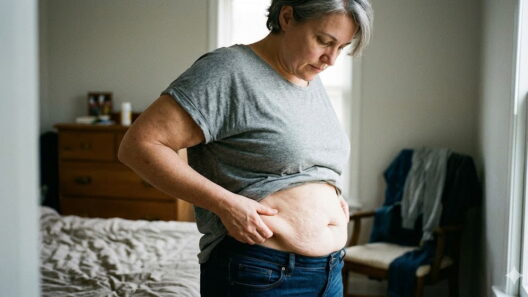





Loose skin after weight loss is one of those things nobody warns you about before you start your journey. You lose the weight, you hit your goal, and then you look in the mirror and wonder why your skin looks the way it does.
This article breaks down exactly what loose skin is, why it happens, what mistakes make it worse, and what you can realistically expect.
What Is Loose Skin After Weight Loss
Loose skin is simple. Your muscles decreased but your skin did not shrink at the same rate. That is it. No rocket science.
Think of it this way — your skin stretched to accommodate the extra weight and fat your body was carrying. When that weight disappears, especially quickly, the skin does not always bounce back to fit the smaller body underneath it.
The best way to understand it is with two bodybuilders. One maintains his training consistently over years — his size reduces slowly but his skin adjusts along the way and stays relatively tight. The other suddenly quits the gym completely. His muscle mass drops fast, his size decreases, but his skin — which had stretched to fit a much larger frame — is now left with nothing to fill it. That loose, hanging skin is exactly what happens after extreme weight loss too.
Loose Skin vs Fat — What Most People Get Wrong
A lot of people confuse loose skin and fat. They are not the same thing and understanding the difference matters.
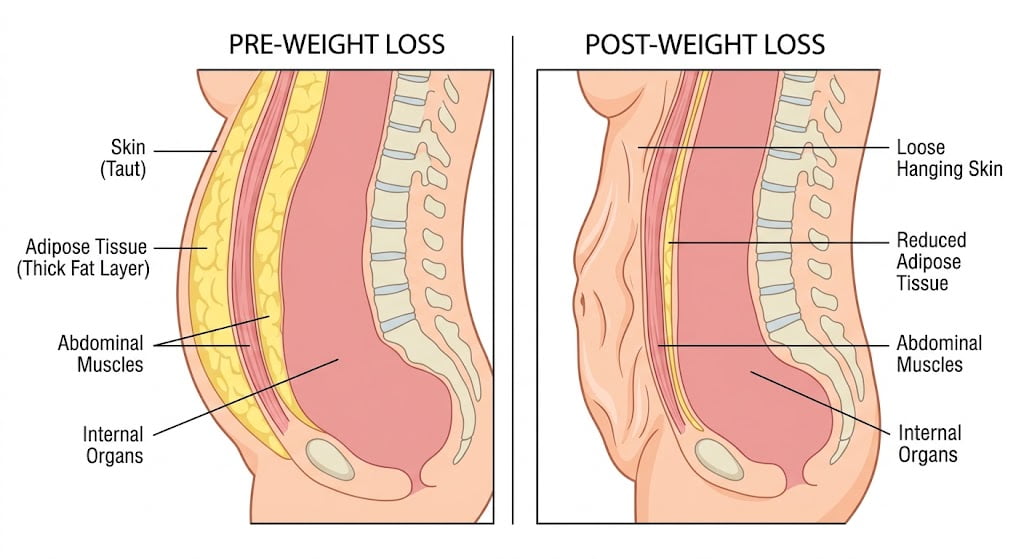
Fat is a substance. When you gain fat, your body adds mass on top of your muscles. The muscles are still there — they are just hidden underneath layers of fat. Here is the thing though — even when fat is present, skin stays relatively tight because the fat itself is filling the space and giving the skin something to sit against.
Loose skin after losing weight is different. The fat is gone. The muscles may still be there but they are smaller than before. What you are left with is skin that has lost its underlying support — the fat that was filling it out is no longer there. That hanging, sagging appearance is not fat. It is skin that has nothing to fill it anymore.
So when someone pinches what they think is stubborn fat and it feels thin and almost empty — that is almost certainly loose skin, not fat. True fat has substance and resistance when you press it. Loose skin feels thin, almost papery, and folds easily.
Why Does Loose Skin Happen After Weight Loss
Loose skin after losing weight happens for several reasons:
Extreme weight loss without proper guidance. This is the biggest one. When you lose weight too fast, your skin simply does not have time to adapt. Skin is elastic but that elasticity has limits. Slow, gradual weight loss gives skin time to shrink along with your body. Rapid weight loss does not.
Age. Younger skin has more collagen and elastin — the proteins that give skin its bounce and ability to snap back. The older you are, the less elasticity your skin has, and the less likely it is to tighten on its own after weight loss.
Genetics. Some people are simply genetically predisposed to having more elastic skin than others. Two people can lose the exact same amount of weight at the exact same pace and end up with very different results purely because of genetics.
How long you were overweight. The longer your skin was stretched, the more damage was done to the collagen and elastin fibers. Someone who carried extra weight for 15 years will have more loose skin after weight loss than someone who carried it for 2 years, even if the total weight lost is the same.
Medical conditions or accidents. Certain medical conditions and physical trauma that cause rapid muscle and weight loss can also result in loose skin — for the same reason. The body loses mass faster than the skin can adapt.
Mistakes That Make Loose Skin After Weight Loss Worse
This is where most people go wrong — and where loose skin goes from manageable to severe.
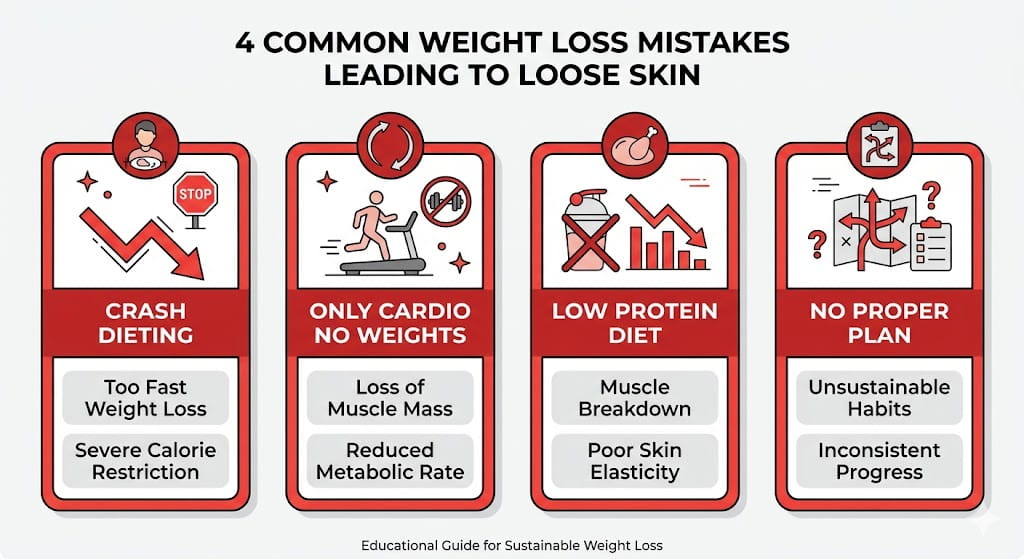
Losing weight too fast. The number one mistake. Everyone is chasing influencer transformations — the person who lost 30 pounds in 6 weeks with perfect skin. Here is the truth about those transformations: if someone lost extreme amounts of weight in 1 to 2 months without any loose or saggy skin, there is a 100 percent chance steroids or other substances were involved. That is not a natural result. Stop comparing yourself to those transformations. They are not real in the way they are presented.
Slow weight loss — 1 to 2 pounds per week maximum — gives your skin the best possible chance to adapt as you go.
Only doing cardio and ignoring weight training. Cardio burns calories. It does not build the muscle that fills your skin from the inside. When you lose fat through cardio alone without building or maintaining muscle, you end up with less mass under your skin — which makes loose skin after losing weight far more visible and pronounced.
Compound weight training — squats, deadlifts, bench press, rows — builds and maintains muscle mass while you lose fat. The muscle fills the space the fat left behind and gives your skin something to sit against. This is the single most effective non-surgical thing you can do for loose skin.
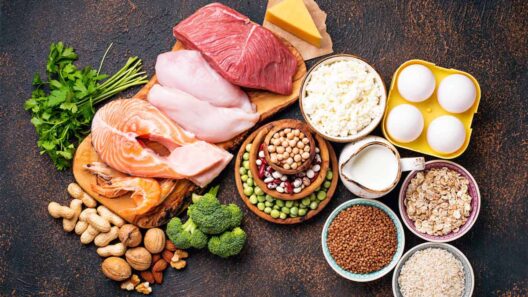
Not eating enough protein. Protein is what your body uses to maintain muscle mass during weight loss. It is also what collagen — the main structural protein in skin — is made from. A low protein diet during weight loss means your body loses muscle faster and your skin has fewer building blocks to repair and maintain its elasticity.
No plan, no BMR, just copying someone else. Losing weight by copying an influencer’s routine without knowing your own BMR, calorie deficit, or nutritional needs is one of the most common reasons people end up with extreme loose skin after weight loss. What works for someone else’s body, metabolism, and starting point will not necessarily work for yours. Calculate your BMR. Know your calorie deficit. Follow a plan built for your body — not someone else’s.
Smoking and alcohol. Both destroy skin elasticity. Smoking reduces blood flow to the skin and breaks down collagen. Alcohol dehydrates the body and skin, reducing elasticity over time. If you are losing weight while regularly smoking or drinking heavily, you are actively making loose skin worse. This applies not just during weight loss but in everyday life — both habits age skin significantly faster than normal.
Does Loose Skin Go Away On Its Own
This is the question everyone wants answered — and the honest answer is: sometimes yes, sometimes no.
Loose skin after weight loss can go away on its own if the amount of loose skin is relatively minor, you are younger and have better natural skin elasticity, you are doing weight training and building muscle underneath, your diet is protein rich and supports collagen production, and genetics are working in your favor.
Skin can continue tightening for a long time after weight loss. Give it at least 2 years before drawing conclusions. Skin firms up gradually — sometimes for up to 2 years after you reach your goal weight. Most people do not give it enough time before deciding something is wrong.
However — if you were significantly overweight for many years, lost a very large amount of weight quickly, are older, or have a combination of these factors, loose skin after losing weight is unlikely to go away completely on its own. In those cases, the options are either learning to manage and minimize it through exercise and nutrition, exploring non-surgical treatments, or in severe cases, surgery — which we cover in detail in our separate guide on how to tighten loose skin after weight loss.
Loose Skin After Weight Loss in Females — And the Breast Question
Women have a specific concern that comes up constantly when talking about loose skin after weight loss — breast changes.
Here is the straightforward answer: if you lose weight, you will lose size everywhere. That includes your chest. This is completely normal and expected. Fat is not your body’s actual structure — your muscles and bones are. Fat simply adds volume on top of that structure. When the fat goes, the volume goes with it — including in the chest area.
What women are often actually concerned about is not just size reduction but sagging — and those are two different things.
Man boobs are a separate issue that affects some men during weight loss. Some men confuse excess chest fat with loose skin. Chest fat in men — sometimes called man boobs or gynecomastia — is fat accumulation in the chest area and is different from loose skin. As overall body fat reduces, chest fat reduces too. However, if the chest area sags or hangs after significant fat loss, that can involve loose skin as well.
For women specifically — sagging after weight loss, breast size reduction, and what you can do about both — we cover this in full detail in our dedicated guide: [How to Fix Sagging Breasts After Weight Loss — What Actually Works]
How Much Weight Loss Causes Loose Skin
There is no exact number — but here is what we know.
The more total weight you lose, the higher the risk of loose skin after weight loss. Losing 20 pounds gradually over 6 months at a healthy pace with strength training will result in far less loose skin than losing 50 pounds in 3 months through crash dieting and cardio alone.
The combination of how much weight, how fast, how long you were overweight, and your age and genetics together determine how much loose skin you end up with — not any single factor alone.
Will Loose Skin Go Away — Realistic Expectations
Here is what realistic looks like:
Minor loose skin in someone young who lost weight gradually with strength training — very likely to improve significantly or disappear over 1 to 2 years.
Moderate loose skin in someone mid-age who lost weight at a reasonable pace — will improve with exercise and nutrition but may not disappear completely.
Significant loose flabby skin after weight loss in someone older who lost large amounts of weight quickly — will improve somewhat with exercise and time but is unlikely to fully resolve without treatment or surgery.
The bottom line on loose skin after losing weight — give it time, give it protein, give it muscle, and give it at least 2 years before you decide what you are actually dealing with.
Frequently Asked Questions
Q1. Does loose skin go away after weight loss?
It depends on how much loose skin there is, your age, genetics, and how fast you lost the weight. Minor loose skin in younger people often tightens significantly over 1 to 2 years with proper nutrition and strength training. Significant loose skin from large, rapid weight loss is less likely to go away completely on its own.
Q2. What is the difference between loose skin and fat?
Fat has substance — it adds mass and volume on top of your muscles. Even with fat present, skin stays relatively tight because the fat fills the space underneath it. Loose skin is what remains when the fat is gone but the skin has not shrunk to match. It feels thin, folds easily, and has no real substance when you press it.
Q3. How much weight loss causes loose skin?
There is no fixed number but the more weight lost and the faster it is lost, the higher the risk. Losing large amounts of weight quickly through crash dieting with no strength training almost always results in some loose skin after weight loss. Slow, gradual weight loss with muscle building significantly reduces the risk.
Q4. Will loose skin go away on its own?
Sometimes. Minor cases in younger people with good genetics who are building muscle often see significant improvement over time. Give it at least 2 years. Skin continues tightening for up to 2 years after reaching goal weight. Severe cases are unlikely to resolve completely without intervention.
Q5. Does loose skin after weight loss go away faster with exercise?
Yes — specifically strength training and compound exercises. Building muscle fills the space left by lost fat and gives skin something to sit against. Combined with a high protein diet and proper hydration, exercise is the most effective natural approach to improving loose skin after losing weight.
Q6. What makes loose skin worse after weight loss?
Losing weight too fast, only doing cardio without weight training, low protein diet, smoking, heavy alcohol consumption, and losing weight without a proper plan based on your BMR and calorie deficit. All of these contribute to more severe loose flabby skin after weight loss.
Q7. Can loose skin from weight loss be mistaken for fat?
Yes — very commonly. The key difference is that loose skin feels thin and almost empty when you press it, while fat has substance and resistance. If you have reached a healthy body fat percentage and still see hanging skin, it is almost certainly loose skin after losing weight rather than remaining fat.
For a complete guide on how to actually fix and tighten loose skin after weight loss through exercise, nutrition, and treatment options, read our detailed guide: [How To Tighten Loose Skin After Weight Loss — Natural and Medical Options]
For women concerned about breast changes after weight loss, read: [How to Fix Sagging Breasts After Weight Loss]
For your complete weight loss foundation, visit our Complete Weight Loss Guide.
Disclaimer
The information in this article is for educational purposes only and does not constitute medical advice. Always consult a qualified healthcare professional before making changes to your diet, exercise routine, or considering any medical treatment.
Sources
- Gould, D.J. et al. (2016) — Factors affecting loose skin after weight loss. Aesthetic Surgery Journal. https://doi.org/10.1093/asj/sjw036
- Dunican, K.C. et al. (2007) — Protein intake and muscle preservation during weight loss. Journal of the American College of Nutrition. https://doi.org/10.1080/07315724.2007.10719608
- Proksch, E. et al. (2014) — Oral supplementation of specific collagen peptides has beneficial effects on human skin physiology. Skin Pharmacology and Physiology. https://doi.org/10.1159/000351376
- Tanaka, H. et al. (2001) — Age and skin elasticity decline. Journal of Applied Physiology. https://doi.org/10.1152/jappl.2001.91.6.2581
- Morita, A. (2007) — Tobacco smoke causes premature skin aging. Journal of Dermatological Science. https://doi.org/10.1016/j.jdermsci.2007.05.015

ISSA Certified Personal Trainer | Nutrition Specialist (Boston University)
Naithen Matthews is an ISSA-certified personal trainer and a nutrition graduate from Cornell University, with advanced graduate study (MS and PhD level work) in Nutrition & Metabolism focusing on nutrient metabolism, energy balance, chronic disease mechanisms, and obesity.
With over five years of experience in fitness coaching and more than two years of writing in the health and wellness space, Naithen specializes in metabolism, women’s health, weight management, and natural wellness. He is passionate about turning complex science into clear, practical guidance that anyone can understand.
Naithen’s work reflects strong E-E-A-T principles, combining real-world coaching experience with evidence-based nutrition knowledge to help readers make safe, informed, and confident health decisions.