

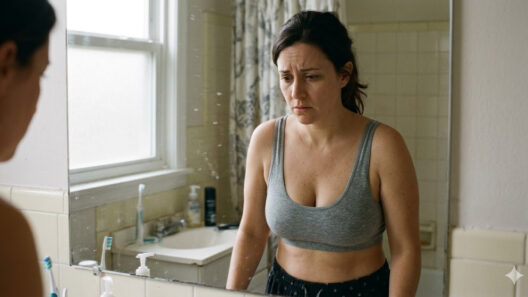


Nobody talks about this part of weight loss openly. You work hard, you lose the weight, and then you look in the mirror and notice your breasts do not look the way they used to. They feel softer. They sit lower. The shape has changed.
If you are asking why do boobs sag after weight loss — you are not alone and you are not imagining it. This is one of the most common concerns women have after significant weight loss, and it deserves an honest answer rather than vague reassurances.
This article covers exactly why boobs sag, what causes it, what actually helps, and what your real options are — from exercises to skincare to surgery.
“If you want to stop sagging from getting worse or prevent it before it starts, read our complete guide on how to prevent boobs from sagging.“
Why Do Boobs Sag — The Simple Explanation
Breasts are made up of fat, glandular tissue, and ligaments called Cooper’s ligaments. These ligaments are what hold your breasts up and give them their shape. They are not muscle — they cannot be strengthened through exercise. Once they stretch, they do not fully bounce back.
When you gain weight, fat accumulates in the breast tissue and the surrounding skin stretches to accommodate the larger size. When you lose that weight — especially quickly — the fat reduces but the stretched skin and ligaments do not automatically shrink back to their original position. The result is breasts that sit lower, feel softer, and appear less full than before.
This is why sagging boobs after weight loss is so common. It is not a failure. It is physics.
What Causes Boobs To Sag — All The Real Reasons
Understanding what causes boobs to sag helps you make sense of what is happening and what can realistically be done about it.
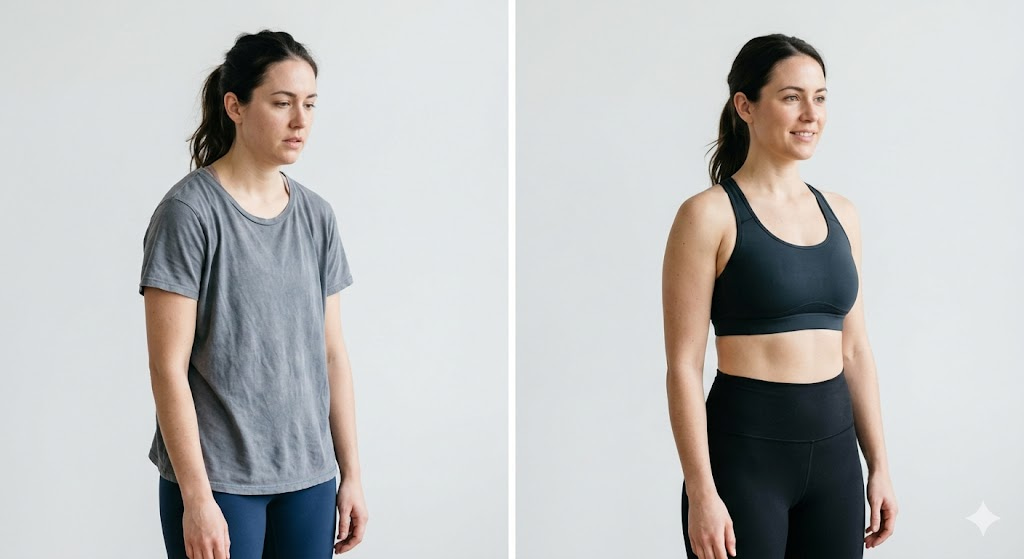
Weight loss — especially rapid weight loss.
This is the most direct cause for most women reading this. The faster the weight loss, the less time the skin has to adapt. Women who lost weight slowly tend to experience less sagging than women who lost the same amount of weight quickly. This is the same principle covered in our guide on loose skin after weight loss — rapid fat loss leaves skin behind.
Age.
As women age, collagen and elastin production naturally decreases. Skin loses its ability to snap back. Cooper’s ligaments weaken over time. This is why sagging boobs become more common and more pronounced with age — and why the same amount of weight loss at 45 produces more sagging than the same loss at 25.
Gravity and lack of support.
Gravity pulls breast tissue downward constantly. Without proper bra support — especially during exercise — Cooper’s ligaments are put under repeated stress and stretch gradually over time. This is one of the most underappreciated causes of what makes boobs sag over years.
Genetics.
Breast shape, skin elasticity, and how Cooper’s ligaments respond to weight changes are all partly genetic. Two women can go through identical weight loss journeys and end up with noticeably different results purely because of genetics.
Smoking.
Smoking breaks down collagen and reduces skin elasticity throughout the entire body — including breast skin. Women who smoke consistently tend to experience more pronounced sagging earlier than non-smokers. This is also discussed in relation to general loose skin in our how to tighten loose skin after weight loss guide.
Pregnancy and breastfeeding.
Both cause significant changes in breast size and skin elasticity. Repeated cycles of expansion and reduction stretch breast skin and ligaments — making sagging more likely even without significant weight loss.
Significant weight fluctuations.
Repeated cycles of losing and regaining weight are particularly damaging to breast shape. Each cycle stretches the skin further. Maintaining a stable healthy weight after reaching your goal is one of the most important things you can do to prevent further sagging.
Why Do My Boobs Sag Even Though I Am Not Overweight
This is a question many women ask — and the answer is that sagging is not exclusively about being overweight.
Why do my boobs sag even at a healthy weight? Several reasons:
Your Cooper’s ligaments may have stretched during a previous period of weight gain or pregnancy. Your genetics may predispose you to less elastic breast skin. Age-related collagen loss affects breast tissue regardless of body weight. Years of inadequate bra support during exercise accumulate over time.
Sagging small boobs is also more common than people realize. Women with smaller breasts often assume they are immune to sagging because there is less weight pulling down — but small breasts sag too, just differently. The shape changes and the position lowers even without significant volume.
How To Fix Sagging Boobs After Weight Loss — What Actually Works
Here is where most content either goes too soft or oversells solutions. Let us be honest about what works and what does not.
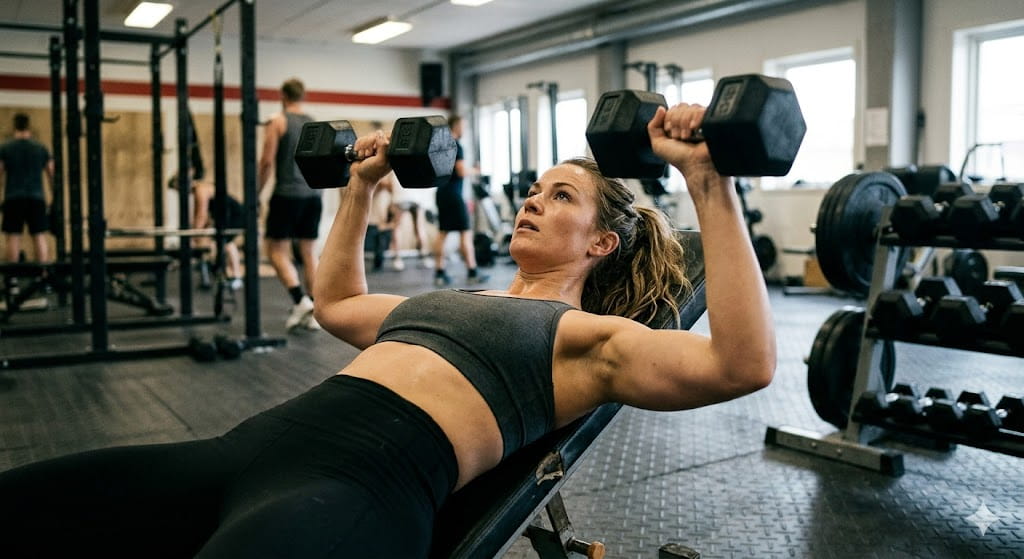
Chest exercises — the most accessible option.
Building the pectoral muscles underneath the breasts does not lift the breasts themselves — but it does push the breast tissue forward and upward, creating a visibly firmer and perkier appearance. This is one of the most reported and genuinely effective non-surgical approaches to improving sagging boobs after weight loss.
Exercises that consistently get results:
Push-ups — one of the most practical and effective chest exercises. Women who incorporated regular upper-body workouts reported noticeably more lift over time. One woman went from a DD to a B cup during weight loss, then back up to a D after consistent lifting and chest work — the underlying muscle changed how everything looked and sat.
The rowing machine — genuinely underrated for this specific concern. One woman described her breasts as looking like they saw a dollar on the ground after weight loss. After consistent rowing machine use, she reported visible improvement. Rowing works the entire upper body — chest, back, and shoulders — which together create better posture and a lifted appearance.
Chest press, dumbbell flyes, and incline push-ups are all worth adding to a regular routine.
Collagen and skin care.
The same principles that apply to loose skin anywhere on the body apply to breast skin. Collagen peptide supplements, vitamin C, retinol, and copper peptide creams support skin elasticity from the inside and outside. For women asking why do my boobs sag and looking for non-surgical skin-focused answers — this is a practical starting point.
A TCA peel has been suggested as a more intensive collagen-boosting treatment for breast skin. Retinol at night and copper peptide cream during the day is a more accessible daily routine that builds results over months.
Results from skincare alone are modest. But combined with exercise and collagen nutrition, they contribute meaningfully to overall improvement.
Proper bra support — immediate and underestimated.
A well-fitted bra does not fix sagging but it makes an enormous visible difference immediately. Most women are wearing the wrong bra size — either too small in the cup or too loose in the band — which means they are getting far less support than they think.
Getting properly measured using a professional bra calculator — the one at abrathatfits.org is widely recommended — can completely change how breasts look and feel in clothes. A better fitting bra with proper support also reduces the ongoing stress on Cooper’s ligaments during daily movement.
For exercise specifically, a proper sports bra is not optional. Repeated unsupported movement during workouts is one of the most consistent causes of progressive ligament stretching over time.
Acceptance and practical management.
This deserves to be said without being dismissive. Many women go through significant weight loss — sometimes losing 50 pounds or more, which you can read about in detail in our guide on how to lose 50 pounds in a few months for a female — and deal with body changes that feel discouraging after all that hard work.
Sagging boobs after weight loss are a sign that your body changed significantly. That is not nothing. The women who feel most at peace with it tend to combine practical steps — good bras, chest exercises, collagen support — with realistic expectations about what non-surgical approaches can achieve.
Surgery — When Exercise and Skincare Are Not Enough
For women with significant sagging after major weight loss, non-surgical options improve the situation but may not fully resolve it. In those cases, surgery is the only option that produces dramatic and permanent results.
Breast lift — mastopexy. A breast lift repositions the breast tissue higher on the chest wall, removes excess skin, and reshapes the breast for a firmer, more lifted appearance. This is the most commonly chosen procedure for sagging boobs after weight loss. One woman who lost over 100 pounds described her breasts as pancakes before getting a lift and augmentation — and said it completely restored her confidence.
Breast implants. For women who lost significant breast volume alongside the sagging, implants restore fullness while a lift addresses the position. One woman whose breasts felt like empty pillowcases after weight loss went to discuss a breast lift and her surgeon recommended small implants instead — which produced a similar lifting effect with easier recovery.
Breast reduction with lift. For women with larger breasts where sagging is combined with excess volume, a reduction and lift together addresses both concerns simultaneously.
Surgery is a significant decision with real costs, recovery time, and permanent results. Make sure your weight has been stable for at least 6 to 12 months before pursuing any procedure — operating during an active weight loss phase is not advisable. Consult a board-certified plastic surgeon and get multiple assessments before deciding.
Frequently Asked Questions
Q1. Why do boobs sag after weight loss?
When you lose weight, fat in the breast tissue reduces but the skin and Cooper’s ligaments that were stretched to accommodate the larger size do not automatically shrink back. The result is breasts that sit lower and appear less full. The faster the weight loss, the more pronounced the sagging tends to be.
Q2. What causes boobs to sag faster than normal?
Rapid weight loss, aging, lack of proper bra support during exercise, smoking, genetics, pregnancy, and repeated cycles of weight gain and loss all accelerate sagging. Of these, rapid weight loss and inadequate support during exercise are the most controllable factors.
Q3. Why do my boobs sag even though I am not overweight?
Sagging is not exclusively related to being overweight. Stretched Cooper’s ligaments from previous weight gain or pregnancy, age-related collagen loss, genetics, and years of inadequate bra support all cause sagging regardless of current body weight.
Q4. Can sagging small boobs be improved without surgery?
Yes — chest exercises that build the pectoral muscles create a visibly perkier appearance even in smaller breasts. Combined with proper bra support and collagen-focused skin care, meaningful improvement is achievable without surgery in most cases.
Q5. Do chest exercises actually fix sagging boobs after weight loss?
Chest exercises do not lift the breast tissue itself — but building the pectoral muscles underneath pushes breast tissue forward and upward, creating a noticeably firmer and more lifted appearance. Women who incorporated consistent upper body training reported visible improvement over time. It is the most effective non-surgical physical approach available.
Q6. How long does it take to see improvement in sagging boobs after weight loss?
With consistent chest training and collagen support, most women start seeing visible improvement within 3 to 6 months. Skin-related improvement through collagen, retinol, and skin care takes longer — up to a year or more. Give the non-surgical approach at least 12 months before considering more intensive options.
Q7. Is surgery the only real fix for significantly sagging boobs?
For significant sagging after major weight loss, surgery is the only option that produces dramatic and permanent results. Exercise and skin care improve the situation meaningfully but have limits. A breast lift, implants, or a combination procedure are the surgical options — consult a board-certified plastic surgeon after your weight has been stable for at least 6 to 12 months.
Sources
- Rinker, B. et al. (2010) — The effect of breastfeeding on breast aesthetics. Aesthetic Surgery Journal. https://doi.org/10.1177/1090820X10375557
- Greenbaum, A.R. et al. (2003) — Cooper’s ligaments and breast ptosis after weight loss. British Journal of Plastic Surgery. https://doi.org/10.1016/S0007-1226(03)00215-2
- Proksch, E. et al. (2014) — Oral collagen peptides improve skin elasticity. Skin Pharmacology and Physiology. https://doi.org/10.1159/000351376
- Morita, A. (2007) — Tobacco smoke causes premature skin aging and collagen breakdown. Journal of Dermatological Science. https://doi.org/10.1016/j.jdermsci.2007.05.015
- Chadbourne, E.B. et al. (2001) — Clinical anatomy of the breast and Cooper’s ligaments. Plastic and Reconstructive Surgery. https://doi.org/10.1097/00006534-200103000-00030
Disclaimer:
The information in this article is for educational purposes only and does not constitute medical advice. Consult a qualified healthcare professional or board-certified plastic surgeon before making any decisions about surgical or medical treatments.

ISSA Certified Personal Trainer | Nutrition Specialist (Boston University)
Naithen Matthews is an ISSA-certified personal trainer and a nutrition graduate from Cornell University, with advanced graduate study (MS and PhD level work) in Nutrition & Metabolism focusing on nutrient metabolism, energy balance, chronic disease mechanisms, and obesity.
With over five years of experience in fitness coaching and more than two years of writing in the health and wellness space, Naithen specializes in metabolism, women’s health, weight management, and natural wellness. He is passionate about turning complex science into clear, practical guidance that anyone can understand.
Naithen’s work reflects strong E-E-A-T principles, combining real-world coaching experience with evidence-based nutrition knowledge to help readers make safe, informed, and confident health decisions.