




Running is often considered one of the simplest and most effective exercises for burning calories. But many people still ask the same question: is running good for weight loss, or are there better options like walking or cycling? The answer is not as simple as “yes” or “no.” It depends on how your body responds, your fitness level, and how consistently you follow a routine.
In our earlier guides, we’ve already discussed weight loss fundamentals, metabolism basics, and different parts of metabolism in detail. If you haven’t read those yet or want deeper background knowledge, you can explore them here for better understanding:
These resources help explain why exercises like running work differently for different people.
Is Running Good for Weight Loss?
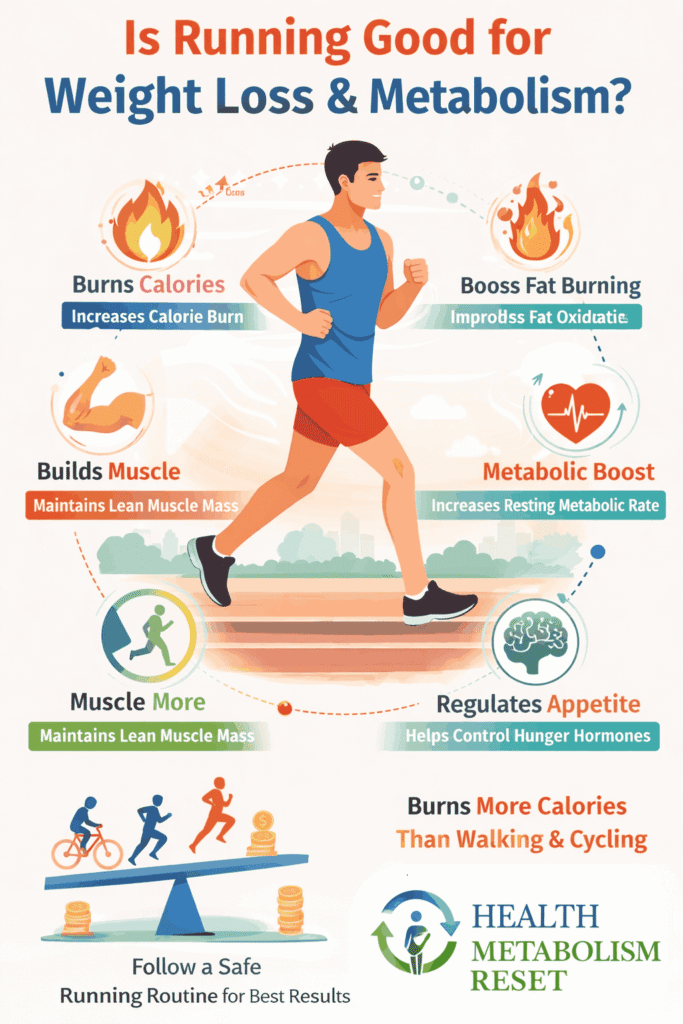
Yes, running is good for weight loss, especially because it burns a high number of calories in a relatively short time. Running increases heart rate, engages multiple muscle groups, and pushes the body to use stored energy. This leads to a higher overall calorie burn compared to many low-intensity activities.
From a metabolic perspective, running not only burns calories during the workout but can also increase post-exercise calorie burn, known as the afterburn effect. This means your body continues using energy even after you’ve finished running.
Research published by the National Institutes of Health (NIH) shows that higher-intensity aerobic exercises like running can improve fat oxidation and overall energy expenditure, which supports weight loss when paired with proper nutrition.
However, weight loss does not depend on running alone. It works best when combined with proper nutrition, recovery, and consistency—topics we’ve already covered in our weight loss and metabolism guides.
Running for Weight Loss: How It Supports Metabolism
Running for weight loss
Running plays a direct role in improving metabolic efficiency. When you run regularly, your body becomes better at using fat and carbohydrates as fuel. Over time, this improves how efficiently your metabolism works.
Running also supports lean muscle maintenance, which is important because muscle tissue burns more calories at rest. A healthier metabolic rate makes it easier to maintain weight loss once achieved.
This is why running is often recommended in running for weight loss programs—it doesn’t just burn calories; it trains your metabolism to work better.
According to Mayo Clinic, regular aerobic exercise helps improve insulin sensitivity and metabolic flexibility, meaning your body becomes better at switching between fat and carbohydrates as fuel.
Is Walking or Running Better for Weight Loss?
This is one of the most common questions: is walking or running better for weight loss?
The honest answer is that both can be effective, but they suit different people.
Running burns more calories per minute, making it efficient for those who can tolerate higher intensity. Walking, on the other hand, is easier on joints, easier to sustain daily, and still effective when done consistently for longer durations.
For beginners or people with joint issues, walking or running for weight loss depends on sustainability. A regular walking routine may lead to better long-term results than inconsistent running.
Walking or Running for Weight Loss: Which Should You Choose?
If your goal is fat loss and improved metabolism:
- Choose running if you are physically comfortable with higher intensity and want faster calorie burn.
- Choose walking if you prefer lower impact, longer sessions, and better consistency.
Many successful weight loss routines actually combine both—walking on rest days and running on active days. This balanced approach reduces injury risk while keeping metabolism active.
Benefits of Running for Weight Loss
The benefits of running for weight loss go beyond calorie burn.
Running helps:
- Improve cardiovascular health
- Increase insulin sensitivity
- Support fat utilization
- Boost overall metabolic rate
- Improve mental clarity and stress management
Stress reduction is important because high stress levels can negatively affect metabolism and weight regulation, a topic we’ve already discussed in our metabolism-related guides.
Research from Cleveland Clinic highlights that regular running supports heart health, improves oxygen utilization, and reduces stress levels.
Running Program for Weight Loss: What Works Best
An effective running program for weight loss does not require extreme intensity. Instead, it focuses on structure and recovery.
Most programs include:
- Short runs for beginners
- Gradual increases in distance or time
- Rest days to allow recovery
- Combination of steady runs and light intervals
Consistency matters more than speed. Overtraining can slow progress by increasing fatigue and injury risk.
Running Schedule for Weight Loss (Beginner-Friendly Approach)
A simple running schedule for weight loss often works best:
- 3–4 running sessions per week
- 20–40 minutes per session
- One or two lighter recovery days (walking or stretching)
This approach supports calorie burn without overwhelming the body. Combined with proper nutrition—covered in our weight loss food guides—this schedule can support steady fat loss.
According to American Council on Exercise (ACE)
Is Cycling Better Than Running for Weight Loss?
Another common question is: is cycling better than running for weight loss?
Cycling is excellent for calorie burn and cardiovascular health, especially for people with joint sensitivity. However, studies referenced by Harvard Health suggest that running generally burns more calories per minute than cycling. That said, cycling can still be equally effective if done at moderate to high intensity for longer periods.
That said, cycling can be just as effective if done at moderate to high intensity for longer durations. The best exercise is ultimately the one you can maintain consistently.
Is Running Good for Metabolism in the Long Term?
Running can support metabolism long-term when done correctly. It improves energy utilization, supports muscle maintenance, and enhances overall metabolic health. However, excessive running without proper nutrition can lead to fatigue and metabolic slowdown.
According to the World Health Organization (WHO), regular physical activity improves metabolic efficiency and reduces the risk of metabolic disorders.
This is why understanding metabolism—its parts and how it works—is crucial. If you want a deeper explanation, refer to our metabolism guide, where we break down these processes in detail.
My Personal Running Routine (Real-Life Example)
In my daily life, I run 4 days a week (Morning), covering around 6 kilometers per day. I keep 2 days for complete rest, allowing my body to recover properly. Sunday is my sprint day, where I focus on short bursts of speed along with stretching and joint mobility exercises.
This routine helps me:
- Maintain calorie burn
- Improve cardiovascular fitness
- Protect joints and muscles
- Avoid overtraining
If you’re looking for a practical approach, you can adapt a running schedule for weight loss similar to this, based on your fitness level. Recovery days are just as important as running days for metabolic health.
Which Muscles Are Most Affected During Running?
Running is not just a cardio exercise—it also engages and develops multiple muscle groups throughout the body. While it does not build bulky muscles like heavy weight training, regular running helps strengthen, tone, and condition several key muscles, especially in the lower body and core.
Understanding which muscles develop during running helps explain why running improves overall strength, posture, and movement efficiency.
1. Leg Muscles (Primary Muscles Used in Running)
The legs are the most active muscles during running.
- Quadriceps (front of thighs):
These muscles work continuously to extend the knee and absorb impact every time your foot hits the ground. Regular running helps strengthen and tone the quadriceps. - Hamstrings (back of thighs):
Hamstrings help pull the leg backward and control movement during the running stride. Running improves their endurance and coordination. - Calf Muscles (gastrocnemius & soleus):
Calves play a major role in pushing the body forward. They become stronger and more defined with consistent running, especially during uphill running or sprinting.
2. Glute Muscles (Hip and Power Muscles)
The glutes are among the most important muscles developed during running.
- They help stabilize the hips
- They generate forward propulsion
- They protect the lower back and knees
Running—especially sprinting, uphill running, or longer distances—activates the glutes significantly. Strong glutes improve running efficiency and reduce injury risk.
3. Core Muscles (Stability and Balance)
Running also engages the core muscles, including:
- Abdominals
- Obliques
- Lower back muscles
The core helps maintain posture, balance, and stability while running. Over time, regular running improves core strength and endurance, even though it may not create visible abs like targeted core exercises.
4. Hip Flexors
Hip flexors lift the legs forward with each stride. These muscles work constantly during running and become stronger with consistent training. Tight hip flexors are common in runners, which is why stretching and mobility exercises are important—something you already include on your sprint day.
5. Upper Body Muscles (Secondary Support)
Although running mainly targets the lower body, the upper body also plays a supporting role.
- Shoulders and arms help maintain rhythm and balance
- Upper back muscles support posture
Good arm movement reduces energy waste and improves running efficiency, especially during longer runs.

Does Running Build Muscle or Just Burn Fat?
Running primarily builds muscle endurance and tone, not large muscle size. It strengthens muscles while simultaneously supporting fat loss, which is why runners often appear lean rather than bulky.
For better muscle development:
- Combine running with strength training
- Include sprint days (as you already do)
- Focus on recovery and proper nutrition
This balanced approach supports both metabolism and muscle health.
Why Muscle Development Matters for Metabolism
Muscle tissue burns more calories at rest than fat tissue. By strengthening leg, glute, and core muscles, running indirectly supports a healthier metabolism. This explains why running is often effective for long-term weight management when combined with proper food choices and rest.
Final Verdict: Is Running a Good Choice or Not?
So, is running a good way to lose weight?
Yes, but it is not the only option.
Running is a powerful tool for:
- Burning calories efficiently
- Improving metabolic health
- Supporting weight loss when paired with proper nutrition
However, walking and cycling are also effective alternatives depending on your fitness level and preferences. Sustainable weight loss comes from consistency, not just intensity.
For best results, combine running with:
- A balanced weight loss plan
- Proper food choices
- Understanding of metabolism fundamentals
You can explore our detailed guides on these topics to build a complete, long-term strategy.
Is running good for metabolism?
Yes, running is good for metabolism because it increases calorie burn, improves energy utilization, and supports overall metabolic efficiency. Regular running helps the body use fat and carbohydrates more effectively as fuel.
Is running good for weight loss?
Running is an effective exercise for weight loss because it burns a high number of calories in a short time. When combined with proper nutrition and recovery, running can help create a calorie deficit that supports fat loss.
How often should I run for weight loss?
For most people, running 3–4 days per week is enough for weight loss. Adding rest days helps recovery and prevents overtraining, which is important for long-term metabolic health.
What is a good running schedule for weight loss?
A balanced running schedule may include 4 running days, 2 rest days, and 1 sprint or interval day with stretching and joint mobility. This approach supports calorie burn while protecting joints and muscles.
Does running help burn belly fat?
Running helps burn overall body fat, including belly fat, by increasing total calorie expenditure. Spot fat reduction is not possible, but consistent running can reduce body fat over time.
Is running alone enough for weight loss?
Running helps with weight loss, but it works best when combined with a healthy diet, proper sleep, and recovery. Nutrition plays a major role in achieving sustainable results.
Disclaimer
The information provided on this website is for educational and informational purposes only and is not intended as medical advice, diagnosis, or treatment. Content related to metabolism, fast metabolism symptoms, nutrition, or health conditions is based on publicly available medical research, clinical studies, and general health references.
This website does not replace professional medical consultation. Always seek the advice of a qualified physician, dietitian, or other licensed healthcare provider regarding any medical condition, symptoms, or changes to your diet, exercise routine, or treatment plan. Never disregard professional medical advice or delay seeking it because of information you have read on this site.
Individual health conditions and metabolic responses can vary. What works for one person may not be appropriate for another. If you experience persistent symptoms, unexplained weight changes, fatigue, or any health concerns, consult a healthcare professional promptly.
Use of the information on this website is at your own risk.
Medical Sources Referenced
World Health Organization (WHO) – Physical activity guidelines
https://www.who.int/news-room/fact-sheets/detail/physical-activity
Harvard Health Publishing – Exercise & calorie burn
https://www.health.harvard.edu/staying-healthy/the-truth-about-metabolism
National Institutes of Health (NIH) – Physical activity & metabolism
https://www.ncbi.nlm.nih.gov/books/NBK555927/
Mayo Clinic – Exercise and weight loss
https://www.mayoclinic.org/healthy-lifestyle/weight-loss/in-depth/exercise/art-20050999
Healthline – Walking vs running for weight loss
https://www.healthline.com/health/walking-vs-running
Cleveland Clinic – Benefits of aerobic exercise
https://my.clevelandclinic.org/health/articles/7050-aerobic-exercise
Disclaimer
The information provided on this website is for educational and informational purposes only and is not intended as medical advice, diagnosis, or treatment. Content related to metabolism, fast metabolism symptoms, nutrition, or health conditions is based on publicly available medical research, clinical studies, and general health references.
This website does not replace professional medical consultation. Always seek the advice of a qualified physician, dietitian, or other licensed healthcare provider regarding any medical condition, symptoms, or changes to your diet, exercise routine, or treatment plan. Never disregard professional medical advice or delay seeking it because of information you have read on this site.
Individual health conditions and metabolic responses can vary. What works for one person may not be appropriate for another. If you experience persistent symptoms, unexplained weight changes, fatigue, or any health concerns, consult a healthcare professional promptly.
Use of the information on this website is at your own risk.
Blog History
This article is regularly reviewed and updated by our medical research team to ensure accuracy, relevance, and evidence-based insights.
Blog History
Posted On:
Last Upadted:

Robert Harisson
ISSA Certified Personal Trainer | Nutrition Specialist (Cornell University)
Robert Harrison is an ISSA-certified personal trainer and a nutrition graduate from Cornell University. With over five years of fitness coaching and two years of health-blog writing, he specializes in metabolism, women’s health, weight management, and natural wellness. Robert creates simple, science-backed content that helps readers make safe and informed decisions. His work reflects strong E-E-A-T principles, combining real-world coaching experience with evidence-based nutrition knowledge.