




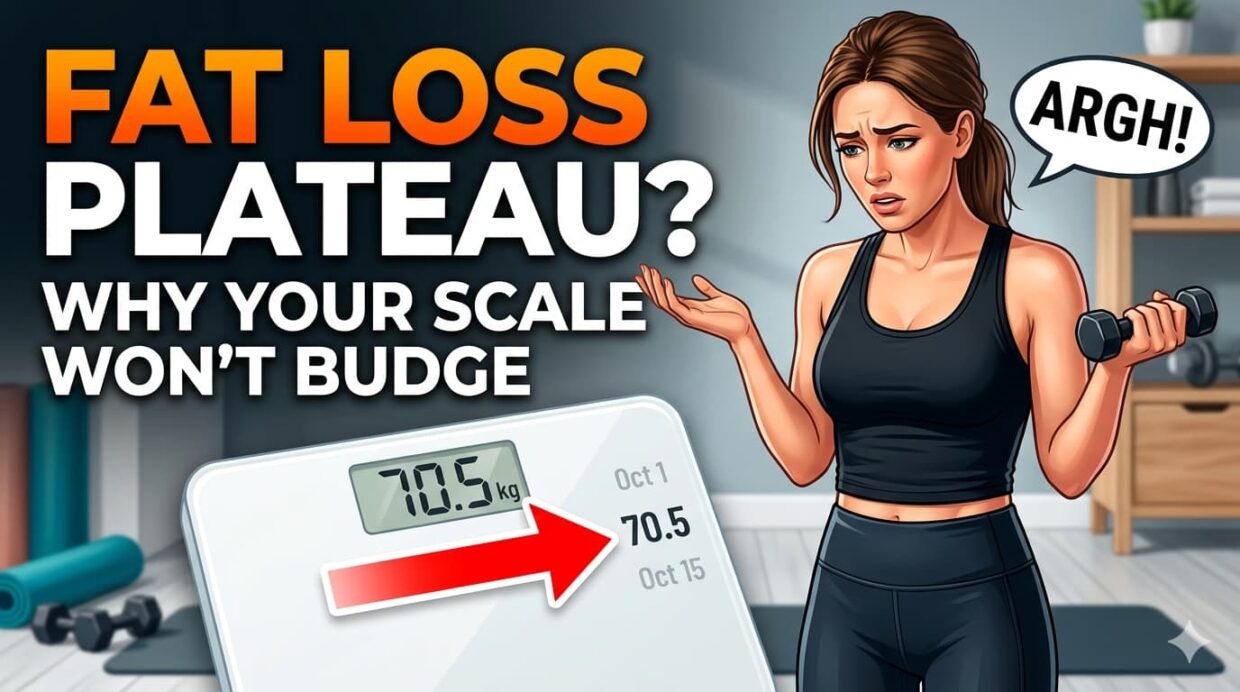
Why Your Scale Won’t Budge — Even When You’re Doing Everything Right
A real woman’s question, a real deep-dive answer: the hidden fat loss plateau reasons behind a stalled journey at 48% body fat.
A reader recently wrote to us with something that stopped me mid-scroll. She is 30 years old, 153 cm tall, weighing 70 kg with approximately 48–49% body fat. She has been strength training three times a week for four years, doing 20–30 minutes of cardio, walking daily, cutting refined sugar, never drinking alcohol, eating in a 200–300 kcal deficit, and treating herself to outside food just once a month. Her thyroid, cortisol, PCOD, and PCOS panels all came back normal. And yet — the scale has not moved in four months.
If you are reading this and nodding, this blog is for you. Let us go through the real fat loss plateau reasons one by one, in plain language, with practical examples from real people.
READ GUIDE: Weight Loss Guide
What Are Fat Loss Plateau Reasons and Why Do They Happen?
A fat loss plateau is not a mystery. It is your body responding intelligently to the environment you have created. When you eat less and move more for a long period, your body adapts — and those adaptations are exactly the fat loss plateau reasons that stop progress cold.
The frustrating part is that these reasons are invisible. You cannot feel your metabolism slowing down. You cannot see your NEAT dropping. You do not notice that your body has quietly closed the calorie gap you worked so hard to create. But the science is very clear on this, and once you understand what is happening, you can fix it.
Fat Loss Plateau Reason 1 — Metabolic Adaptation
One of the most overlooked fat loss plateau reasons is metabolic adaptation, also called adaptive thermogenesis. When you eat in a small calorie deficit for months or years, your body quietly fights back. It lowers your resting metabolic rate. It reduces the energy cost of your workouts. And most silently of all, it reduces your unconscious daily movement — the fidgeting, the extra steps, the small physical choices you make without thinking. Scientists call this NEAT: Non-Exercise Activity Thermogenesis.
This is one of the core fat loss plateau reasons that never gets discussed enough. Your 200–300 kcal deficit on paper may have become zero in reality — not because you changed anything, but because your body closed the gap on its own.
Real-life example: Priya, a 32-year-old software engineer from Pune, was eating 1,500 kcal a day and training four times a week. After eight months, fat loss completely stopped. When she wore a fitness tracker for a full week, she discovered she was burning 350–400 fewer calories per day than she had been at the start. Not from fewer workouts — but from incidental movement having quietly collapsed. Her body had adapted. She took a two-week diet break at maintenance calories, reset her metabolism, and then restarted her deficit. The plateau broke within six weeks.
Fat Loss Plateau Reason 2 — Calorie Counting Errors
Another one of the common fat loss plateau reasons is that the deficit you think you are in does not actually exist. Food labels carry a margin of error of up to 20%. Home estimates, especially for Indian cooking with oils and ghee, can undercount calories by 30–40%. A “small” pour of oil in a pan can easily be two to three tablespoons instead of one — that alone is 200–300 extra calories per day. Over a week, that erases your entire weekly deficit.
This is not about willpower or cheating. It is about the practical difficulty of estimating food accurately without a kitchen scale. Weigh your food — especially oils, nuts, rice, and roti — for just ten days. Use a more accurate app like Cronometer, which has better coverage of Indian foods than MyFitnessPal. Most people who do this discover hidden calories they never suspected, and this alone is one of the easiest fat loss plateau reasons to fix.
High Body Fat and Leptin Resistance
At around 48–49% body fat, the body has enormous fuel reserves. And your brain knows it — except sometimes it stops reading that signal properly. This is called leptin resistance, and it is one of the less-discussed fat loss plateau reasons in mainstream health content.
Leptin is the hormone that tells your brain: “We have enough stored fuel, it is safe to burn fat.” When leptin signaling breaks down, your brain behaves as if you are in starvation even though you are not. Fat mobilization slows. Hunger increases. The body becomes very reluctant to release stored fat. Combined with a small deficit and a large fat store, this hormonal miscommunication can completely stall progress — and it is one of the physiological fat loss plateau reasons that no amount of “trying harder” will fix without a strategic approach.
Real-life example: Meena, 29, from Chennai, had a nearly identical profile. Her trainer added three 40-minute brisk morning walks specifically in a fasted state — just water before heading out. No diet change. Within ten weeks, the plateau broke. Low-intensity fasted movement uses fat as fuel more efficiently and helps re-sensitize leptin over time. It is one of the most underused solutions for this category of fat loss plateau reasons.
Strength Training Is Excellent — But Not a High Calorie Burner
Three strength sessions per week is genuinely excellent for long-term body composition. But one of the misunderstood fat loss plateau reasons is overestimating how many calories resistance training burns. A 45-minute full-body strength session typically burns 200–350 kcal for someone of this body weight. That is meaningful, but not large enough to carry a deficit on its own if other factors are working against you.
The combination of lower fat mobilization from leptin resistance, a potentially closed calorie gap from metabolic adaptation, and a modest training expenditure means the actual weekly deficit may be close to zero. Understanding this is key to solving these fat loss plateau reasons — because the solution is not to add more intense workouts, but to add more low-intensity movement and address the hormonal and metabolic factors.
What to Actually Change — A Practical Protocol
Now that we have covered the main fat loss plateau reasons, here is what to do about them, in order of priority.
First, take a two-week diet break. Eat at your maintenance calories — roughly 1,700–1,900 kcal for this reader’s stats — for two full weeks. This resets leptin, cortisol, and restores NEAT. This is not giving up. It is a strategy backed by research, and it directly addresses one of the most stubborn fat loss plateau reasons.
Second, increase protein to 100–120 grams per day. Higher protein improves satiety, preserves muscle during a deficit, and has a higher thermic effect — meaning your body burns more calories just digesting it. This is a low-effort, high-impact fix that addresses multiple fat loss plateau reasons at once.
Third, add 5,000–7,000 steps of intentional daily walking, separate from your workouts. This is low-intensity and specifically promotes fat oxidation without triggering the compensatory hunger that high-intensity cardio sometimes does. Track it with a cheap pedometer or your phone. For most people stuck in a plateau, this is the single biggest untapped lever.
Fourth, weigh all food with a kitchen scale for ten days. No estimation. This directly addresses the calorie miscounting that is among the most common practical fat loss plateau reasons.
Fifth, examine sleep quality — not just duration. Poor sleep raises ghrelin (the hunger hormone) and cortisol, both of which directly suppress fat burning. Even seven hours of fragmented sleep can work against you. The lower back pain mentioned in the reader’s question may be disrupting sleep architecture without her realising it, which connects back to the hormonal fat loss plateau reasons discussed earlier.
Sixth, consider a DEXA scan. Body fat percentage measured by scales or calipers can be off by 5–10%. A DEXA scan shows true lean mass and fat mass and may reveal that fat loss is actually happening even when the scale is static — because muscle gain is offsetting fat loss. This distinction matters enormously when evaluating fat loss plateau reasons.
The Lower Back Pain Connection — Do Not Ignore This
Chronic lower back pain, even mild and occasional, creates a low-grade stress response in the body. Elevated cortisol from ongoing pain causes the body to preferentially store fat around the abdomen and lower back — exactly where this reader describes her fat accumulation. Treating the pain is not just about comfort. It may directly improve fat loss outcomes by reducing one of the hormonal fat loss plateau reasons hiding in plain sight.
A physiotherapist assessment, core-strengthening exercises specific to lumbar stability, and addressing anterior pelvic tilt — very common in people who sit for work — can make a meaningful difference in both pain and fat distribution over time.
Final Thought
Four years of disciplined effort is not wasted. It has built genuine cardiovascular health, muscular foundation, and metabolic resilience that a sedentary person simply does not have. The plateau is not a sign of failure. It is the body doing exactly what evolution designed it to do: protect its fuel reserves under perceived scarcity. The fat loss plateau reasons covered in this blog — metabolic adaptation, leptin resistance, calorie miscounting, low NEAT, and chronic pain-related cortisol — are all real, all fixable, and none of them require you to try harder. They require you to try differently.
If you recognise your own situation in this post, start with the diet break and the kitchen scale. Then add the walking. Give it eight weeks. The scale will move.
Have a question you want us to deep-dive? Submit it at healthmetabolismreset.com
Check This Product: New Weight Loss Product Jelly Lean
FAQs
I’m doing everything right but my weight won’t move — is this normal?
Yes, very common. After months in a calorie deficit, your body quietly adapts by slowing metabolism and reducing daily movement. You haven’t failed — your body has just gotten efficient. A 2-week diet break at maintenance calories is usually the first step to breaking through.
I have 48% body fat and have been trying for 4 years — is fat loss still possible for me?
Absolutely yes. At high body fat, leptin resistance slows fat mobilization — it’s hormonal, not a willpower issue. Fasted morning walks, higher protein intake, and strategic diet breaks have helped many women in this exact situation break their plateau.
Can strength training alone break a fat loss plateau, or is cardio necessary?
Strength training is great, but one session only burns 200–350 kcal. Adding 5,000–7,000 extra daily steps — separate from workouts — is more effective for fat oxidation during a plateau than intense cardio, and won’t trigger extra hunger either.
My hormonal tests are all normal but I still can’t lose fat — what else should I check?
Standard panels miss a few things. Chronic back pain silently raises cortisol. Poor sleep quality raises hunger hormones. A DEXA scan gives accurate body composition data. And weighing food with a kitchen scale for 10 days often reveals hidden calories that no test can show.

ISSA Certified Personal Trainer | Nutrition Specialist (Boston University)
Naithen Matthews is an ISSA-certified personal trainer and a nutrition graduate from Cornell University, with advanced graduate study (MS and PhD level work) in Nutrition & Metabolism focusing on nutrient metabolism, energy balance, chronic disease mechanisms, and obesity.
With over five years of experience in fitness coaching and more than two years of writing in the health and wellness space, Naithen specializes in metabolism, women’s health, weight management, and natural wellness. He is passionate about turning complex science into clear, practical guidance that anyone can understand.
Naithen’s work reflects strong E-E-A-T principles, combining real-world coaching experience with evidence-based nutrition knowledge to help readers make safe, informed, and confident health decisions.