
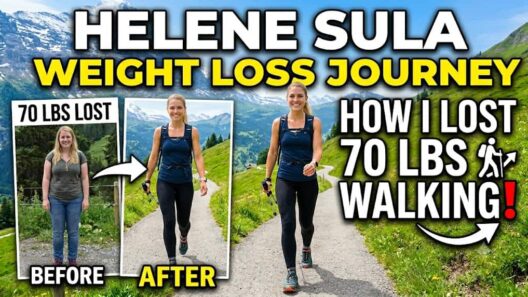




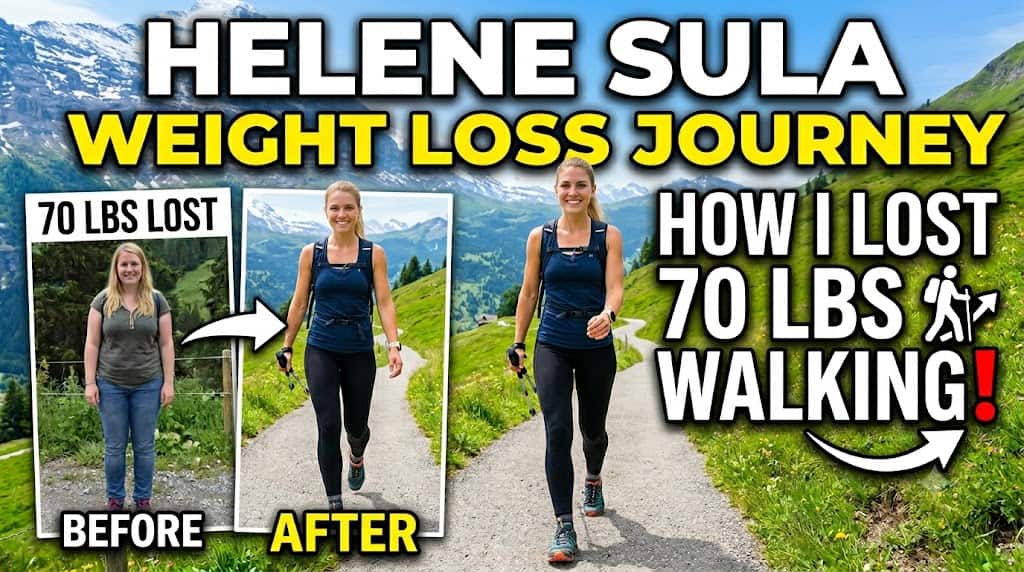
The Helene Sula weight loss journey did not start with a dramatic intervention or a strict diet plan. It started with a decision to walk the Cotswold Way — a 100-mile trail in England — and the realization that she actually needed to prepare her body to do it.
Helene Sula is a 39-year-old travel blogger based in Dallas, Texas, who has visited over 60 countries and documented her life across the world. For years, food was as much a part of her travel identity as the destinations themselves. And for years, her weight reflected that — climbing to what she believes was over 200 pounds on her 5-foot-2-inch frame.
What followed was one of the most practical, sustainable, and genuinely inspiring weight loss transformations documented publicly in recent years. Two years. Seventy pounds. No gym membership. No deprivation. No GLP-1 drugs. Just walking, meal tracking, and a fundamental shift in her relationship with food.
What Started the Helene Sula Weight Loss Journey

The turning point was not a health scare or a dramatic moment. It was a goal.
Helene Sula decided she wanted to walk the Cotswold Way — a stunning 100-mile trail through the English countryside. She gave herself a deadline. She started training in June 2024. Four months later she completed the walk solo in 10 days.
“It was one of the best things I’ve done for myself in my life. Now I’m addicted.”
Since then she has completed the 150-mile Stevenson Trail in France and is planning to walk coast to coast across England — an almost 200-mile trek. The goal created the habit. The habit created the transformation.
This is the element of the Helene Sula weight loss journey that most people overlook — it was not driven by wanting to be thinner. It was driven by wanting to do something physically demanding and meaningful. The weight loss was the result of the goal, not the goal itself.
This distinction matters enormously for anyone struggling with motivation. Our guide on why motivation fails for weight loss covers exactly this — why chasing weight loss as the primary goal so often fails, and why attaching the effort to something meaningful produces different results.
The Helene Sula Weight Loss Journey — What She Actually Did
Walking — The Foundation of Everything
The core of the Helene Sula weight loss journey is walking. Not intense cardio. Not boot camp classes. Walking.
She started using a training app to build her walking capacity progressively — preparing specifically for the Cotswold Way. The structure gave her direction. The goal gave her reason. The consistency gave her results.
Over two years, walking became the non-negotiable foundation of her daily movement. Hiking trails. City walks. Daily step counts. The body she built was built one step at a time.
This challenges the widely held belief that effective weight loss requires intense gym-based exercise. The evidence actually supports what Helene Sula discovered in practice — consistent daily movement at moderate intensity is more sustainable and more effective long term than intense exercise that most people cannot maintain. Our guide on whether running is good for weight loss covers the science behind why moderate consistent movement often outperforms intense sporadic effort.
For anyone who hates the gym or finds intense exercise unsustainable — the Helene Sula weight loss journey is proof that you do not need it. What you need is consistency, and walking delivers that more reliably than almost any other form of exercise.
Meal Tracking — The Tool That Made the Difference
The second pillar of the Helene Sula weight loss journey is meal tracking using MyFitnessPal.
Sula used to eat fast food regularly. As a travel content creator, food was part of the cultural experience of every destination — and she had no intention of giving that up entirely.
“Food is part of a cultural experience. When I travel to a new place, I want to try the food. But I had to reframe my mindset and make it my mission to realize that I can try the food — I just don’t need to eat all of it right then and there.”
This reframe is one of the most important elements of the entire Helene Sula weight loss journey. She did not eliminate foods she loved. She changed her relationship with portion and quantity.
Meal tracking gave her awareness — something she had avoided for years by not looking at scales and not counting anything. Bringing that awareness in without turning it into obsession is the skill she developed, and it is the skill that made tracking sustainable rather than anxiety-inducing.
For anyone starting with meal tracking, our guide on best weight loss foods is a practical starting point — knowing which foods give you the most satiety per calorie makes tracking far less restrictive.
Weekly Weigh-Ins — Using the Scale as a Tool, Not a Judge
For years Helene Sula avoided the scale entirely. Part of her transformation was changing that relationship.
She now weighs herself every Friday — consistently, same conditions, same day. She describes the scale as a tool to help her understand how her body responds to different weeks — not a verdict on her worth or effort.
This is exactly the approach our safe weight loss per week guide recommends — weekly tracking of trends rather than daily reaction to fluctuations. The number on any single day means very little. The trend over weeks and months tells the real story.
No Deprivation — The Mindset That Made It Sustainable
One of the most striking elements of the Helene Sula weight loss journey is what she did not do.
She did not eliminate travel food. She did not give up trying cuisine in foreign countries. She did not follow a restrictive protocol that would have been impossible to maintain across 60 countries.
She changed the quantity, not the category. She built awareness without restriction. She created a deficit through movement and portion consciousness rather than elimination.
This is the approach our complete weight loss guide consistently points to as the most sustainable — because sustainability is the only thing that produces results that last. Seventy pounds over two years is not a dramatic short-term transformation. It is what consistent, sustainable effort actually looks like when given enough time.
How to Lose Weight With Walking — The Foundation of Everything
The Helene Sula weight loss journey is one of the clearest real-world demonstrations of how to lose weight by walking effectively. Here is what her approach teaches:
Give walking a purpose beyond weight loss.
Sula walked to complete trails — not to burn calories. The goal made the walking non-negotiable in a way that pure weight loss motivation could not. Find a walking goal that excites you — a trail, a charity walk, a distance milestone — and train toward it.
Build progressively.
She started training in June 2024 and completed a 100-mile trail four months later. She did not start at 100 miles. She built capacity week by week using a structured app. Progressive overload applies to walking just as it does to strength training.
Combine walking with meal awareness — not restriction.
Walking alone creates a modest daily calorie deficit. Combining it with meal tracking — even without dramatic dietary changes — amplifies the results significantly. The two together are what produced 70 pounds of loss over two years.
Be consistent over months, not intense over weeks.
How to lose weight by walking is fundamentally a question of consistency. The results compound over months the way interest compounds in a savings account. Short bursts of intense effort followed by giving up produce nothing. Steady daily walking maintained for a year produces transformation.
Our weight loss plan for beginners covers how to structure this kind of approach from the very beginning — including how to set realistic weekly targets that compound into significant results over time.
The Emotional Side of the Helene Sula Weight Loss Journey
The physical transformation in the Helene Sula weight loss journey is visible and documented. But the emotional dimension is equally important — and equally instructive.
For years she avoided mirrors in group photos. She stood at the back. She turned away from scales at doctor’s offices. She described feeling distraught and embarrassed at her own body.
The weight loss restored something she described as getting back to herself.
“I am a very positive and outgoing person, but I think over the years, that has gone away a bit because I’ve been embarrassed. I feel like I’ve finally gotten back to myself. It’s been really nice.”
This emotional dimension — the confidence that comes from physical capability rather than just appearance — is something our women’s weight loss guide addresses directly. The goal is not thinness. The goal is feeling capable, energetic, and at home in your body.
The Helene Sula weight loss journey also mirrors patterns seen in other public transformation stories — including the Symone Sanders weight loss story — where the turning point was not a diet but a decision to stop avoiding the reality of where things had gotten to.
What the Helene Sula Weight Loss Journey Teaches About Metabolism
Seventy pounds of sustained weight loss over two years does not happen without metabolic adaptation. Understanding what happens to metabolism during extended weight loss helps explain why the Helene Sula approach worked where so many others fail.
Slow consistent weight loss preserves metabolic rate.
Rapid weight loss — crash diets, extreme calorie restriction — causes the body to down-regulate metabolism aggressively. This is why people who lose weight fast often gain it back fast. Slow loss at 1 to 2 pounds per week — exactly the pace Sula maintained — preserves metabolic rate far more effectively.
Walking improves insulin sensitivity without spiking cortisol.
Unlike intense exercise which raises cortisol, daily walking at moderate intensity improves insulin sensitivity — the body’s ability to process glucose efficiently — without triggering the stress hormone response that can actually impede fat loss. Understanding your basal metabolic rate helps you understand why even moderate daily movement makes such a significant metabolic difference over time.
Consistent hydration and sleep supported the entire process.
Both are metabolic essentials that most people undervalue. How sleep affects metabolism directly — poor sleep disrupts the hunger hormones ghrelin and leptin, making appetite control significantly harder. Sula’s active outdoor lifestyle naturally supported better sleep quality — another reason the walking approach worked as well as it did.
5 Lessons from the Helene Sula Weight Loss Journey
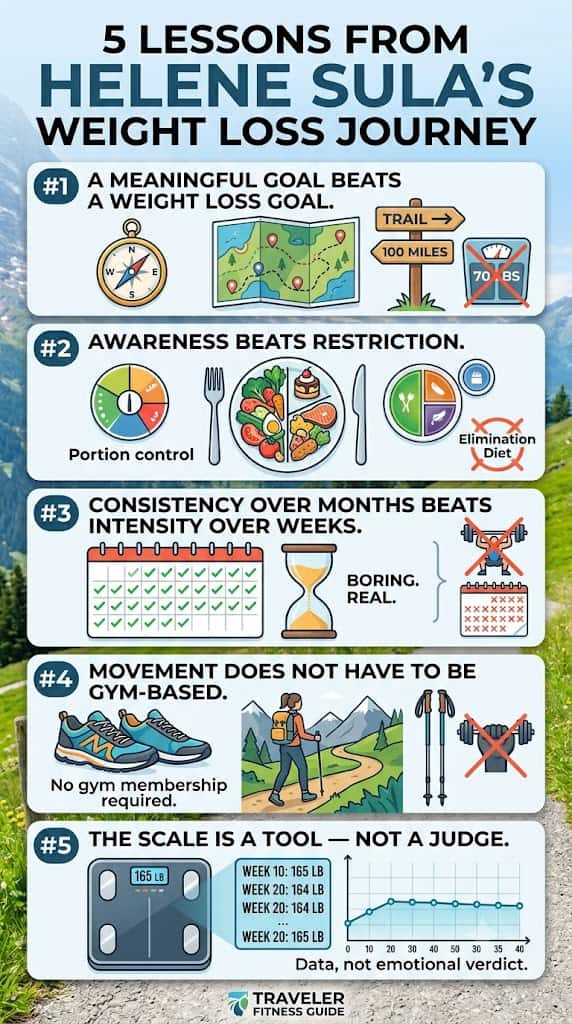
1. A meaningful goal beats a weight loss goal.
Sula did not set out to lose 70 pounds. She set out to walk a 100-mile trail. The weight loss followed. Find your trail.
2. Awareness beats restriction.
Tracking what you eat without eliminating what you love is sustainable. Elimination diets are not — especially for someone whose entire career involves trying new food in new places.
3. Consistency over months beats intensity over weeks.
Two years. Seventy pounds. That is less than 1 pound per week on average. Boring. Sustainable. Real.
4. Movement does not have to be gym-based.
Walking, hiking, and daily active travel built a body that can complete 150-mile trails. No gym membership required. For anyone who wants to add structure, our guide on best exercises to lose belly fat covers how to complement walking with targeted training.
5. The scale is a tool — not a judge.
Weekly weigh-ins used as data rather than emotional verdict changed Sula’s relationship with progress tracking entirely. Use it the same way.
Frequently Asked Questions
Q1. How much weight did Helene Sula lose?
Helene Sula lost 70 pounds over two years — going from what she believes was over 200 pounds to 134 pounds on her 5-foot-2-inch frame. She started her training in June 2024 and has maintained and continued her progress since then.
Q2. How did Helene Sula lose weight?
The Helene Sula weight loss journey was built on three pillars — daily walking and hiking, meal tracking using MyFitnessPal, and a mindset shift around portion awareness rather than food elimination. She did not use GLP-1 drugs or follow a strict diet protocol.
Q3. How to lose weight by walking like Helene Sula?
Start with a meaningful walking goal — a trail, a distance, an event. Build progressively using a structured training plan. Combine daily walking with meal tracking for awareness. Aim for consistency over months rather than intensity over weeks. The results compound significantly over time.
Q4. Did Helene Sula use any weight loss supplements?
Helene Sula has not publicly credited any supplements as part of her weight loss journey. Her transformation was built on walking, meal tracking, and mindset shifts around food — not pharmaceutical or supplemental interventions.
Q5. How long did the Helene Sula weight loss journey take?
Two years of consistent effort. This pace — roughly 35 pounds per year — aligns perfectly with the safe and sustainable rate of 1 to 2 pounds per week that produces lasting results without metabolic damage.
Q6. Can you really lose significant weight just by walking?
Yes — the Helene Sula weight loss journey is real-world proof. Walking combined with meal awareness creates a consistent daily calorie deficit that compounds over months into significant fat loss. It is not the fastest approach but it is one of the most sustainable — especially for people who find intense exercise unsustainable long term.
Q7. What can regular people learn from the Helene Sula weight loss journey?
That sustainable weight loss does not require a gym, a strict diet, or dramatic restriction. It requires consistency, awareness, a meaningful goal to work toward, and enough time for the results to compound. The Helene Sula weight loss journey is proof that boring and sustainable beats intense and short-lived every single time.
Disclaimer:
This article is for educational and informational purposes only. Information about Helene Sula’s weight loss journey is based on publicly available interviews and statements. This does not constitute medical advice. Always consult a qualified healthcare professional before making significant changes to your diet or exercise routine.
Sources
- Lloyd, A. (2025) — Helene Sula lost 50 pounds since May 2024 mostly by walking, hiking, and tracking her meals. Business Insider. https://www.businessinsider.com/helene-sula-weight-loss-walking-hiking-meal-tracking-2025
- Pawlowski, A. (2025) — Woman loses 70 pounds with walking — simple tips that changed everything. TODAY.com. https://www.today.com/health/diet-fitness/woman-loses-70-pounds-walking-diet-tips-rcna349769
- Donnelly, J.E. et al. (2009) — Physical activity and weight loss — walking as primary intervention. Medicine & Science in Sports & Exercise. https://doi.org/10.1249/MSS.0b013e3181949333
- Ekelund, U. et al. (2016) — Daily steps and mortality — dose response meta-analysis. The Lancet. https://doi.org/10.1016/S0140-6736(16)30370-1
- Spiegel, K. et al. (2004) — Sleep deprivation effects on hunger hormones leptin and ghrelin. PLOS Medicine. https://doi.org/10.1371/journal.pmed.0010062
- Ostendorf, D.M. et al. (2019) — Physical activity and long term weight loss maintenance. Obesity. https://doi.org/10.1002/oby.22547

ISSA Certified Personal Trainer | Nutrition Specialist (Boston University)
Naithen Matthews is an ISSA-certified personal trainer and a nutrition graduate from Cornell University, with advanced graduate study (MS and PhD level work) in Nutrition & Metabolism focusing on nutrient metabolism, energy balance, chronic disease mechanisms, and obesity.
With over five years of experience in fitness coaching and more than two years of writing in the health and wellness space, Naithen specializes in metabolism, women’s health, weight management, and natural wellness. He is passionate about turning complex science into clear, practical guidance that anyone can understand.
Naithen’s work reflects strong E-E-A-T principles, combining real-world coaching experience with evidence-based nutrition knowledge to help readers make safe, informed, and confident health decisions.